

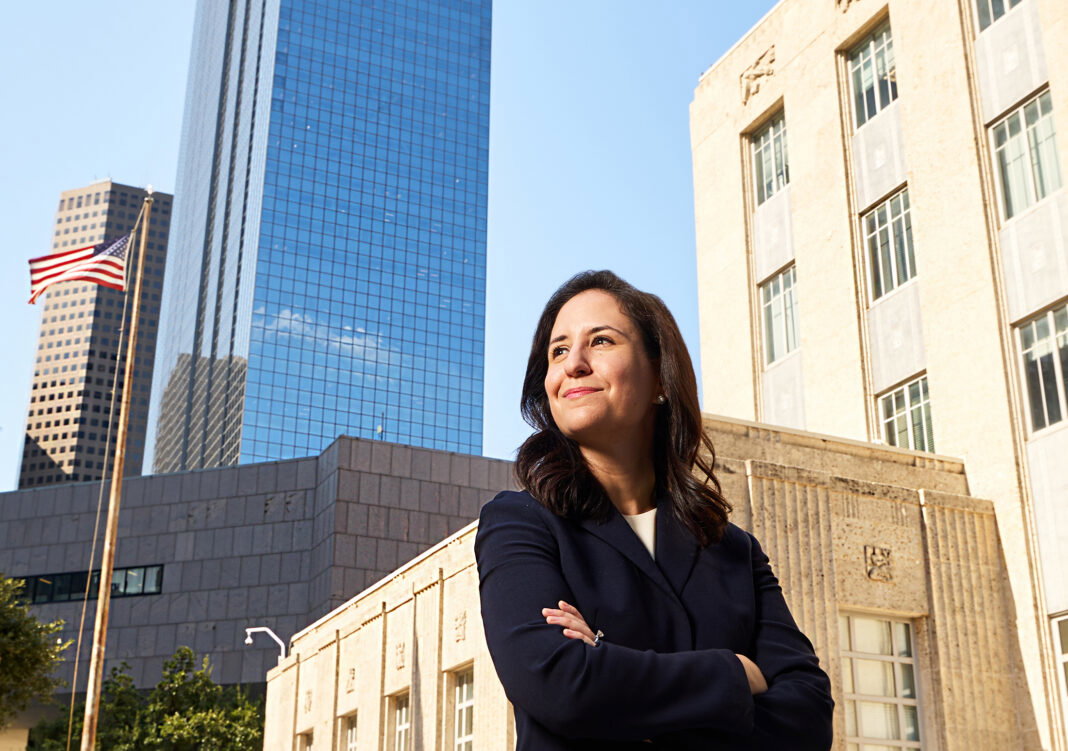
Houston’s first gay Latina city councilmember has made history, but the attention she’s getting goes far beyond identity.
In her first year, At-Large Position 4 Councilmember Alejandra Salinas has passed an ordinance limiting how HPD cooperates with ICE and another requiring landlords to provide air conditioning in rental units. She helped pass a $3 million budget amendment to combat illegal dumping and create a water fund that lets citizens apply for relief from the newly implemented $5 monthly trash fee. She’s also working to make City Hall more accessible by building an online sign-up system for public comment meetings and monthly office hours that let people meet with her one-on-one.
“We’re taking small steps to make City Hall the people’s house and just making folks know that we can pass good policy together,” Salinas says.
In many ways, advocacy is in her blood. Her great-grandfather immigrated from Mexico to the US, worked as a janitor at a meatpacking plant, sweeping the corrals, then bought that same plant and grew it into a business that employed more than 500 people across South Texas. “It was one of the first Latino businesses of its kind at that time,” Salinas says. Later, he built schools in Salinas’s hometown of Laredo—the epitome of the American dream for her family. “He came from nothing and built this really remarkable thing,” she says.
That legacy stuck with her. In high school, she organized a walkout in protest of a bill that would have made it a felony to aid or provide shelter to an undocumented immigrant. “Growing up on the border, that’s basically everybody, all the time, everywhere,” she says. So, when she learned students across the country were protesting, she—a self-described “nerdy debate kid”—joined them, convincing the jocks and cheerleaders to cut class for the cause. “That whole process—it just turned on a light bulb in me, helping people find their voice and fight for themselves,” Salinas says. “There’s nothing like it.”
Her father, a lawyer, encouraged that growing love of advocacy. While attending the University of Texas at Austin, she became national president of the College Democrats and helped organize President Barack Obama’s campaign. And, in 2012, she gave a speech that would also become her coming-out story.
Up until that moment, only her parents and close friends knew she was gay, but with marriage equality dominating national debates, Salinas decided to speak her truth on the convention floor. “It felt like an important platform to maybe make other people feel more comfortable in their own skin,” she says. She identified as an “LGBT Latina,” deliberately using the acronym, guessing that some of her relatives who didn’t speak English might not grasp the term. Headlines followed, with Texas newspapers referring to her as “young, gay, and Latina,” she says—“everything President Obama would want in a surrogate.” Then came the phone calls: “Mijita, the paper says you’re gay. What does this mean?”
The overwhelming support outweighed the discomfort. As she left the arena, kids approached her: “I can’t believe you said it,” she remembers them telling her. “I’m gonna tell my mom tomorrow.”
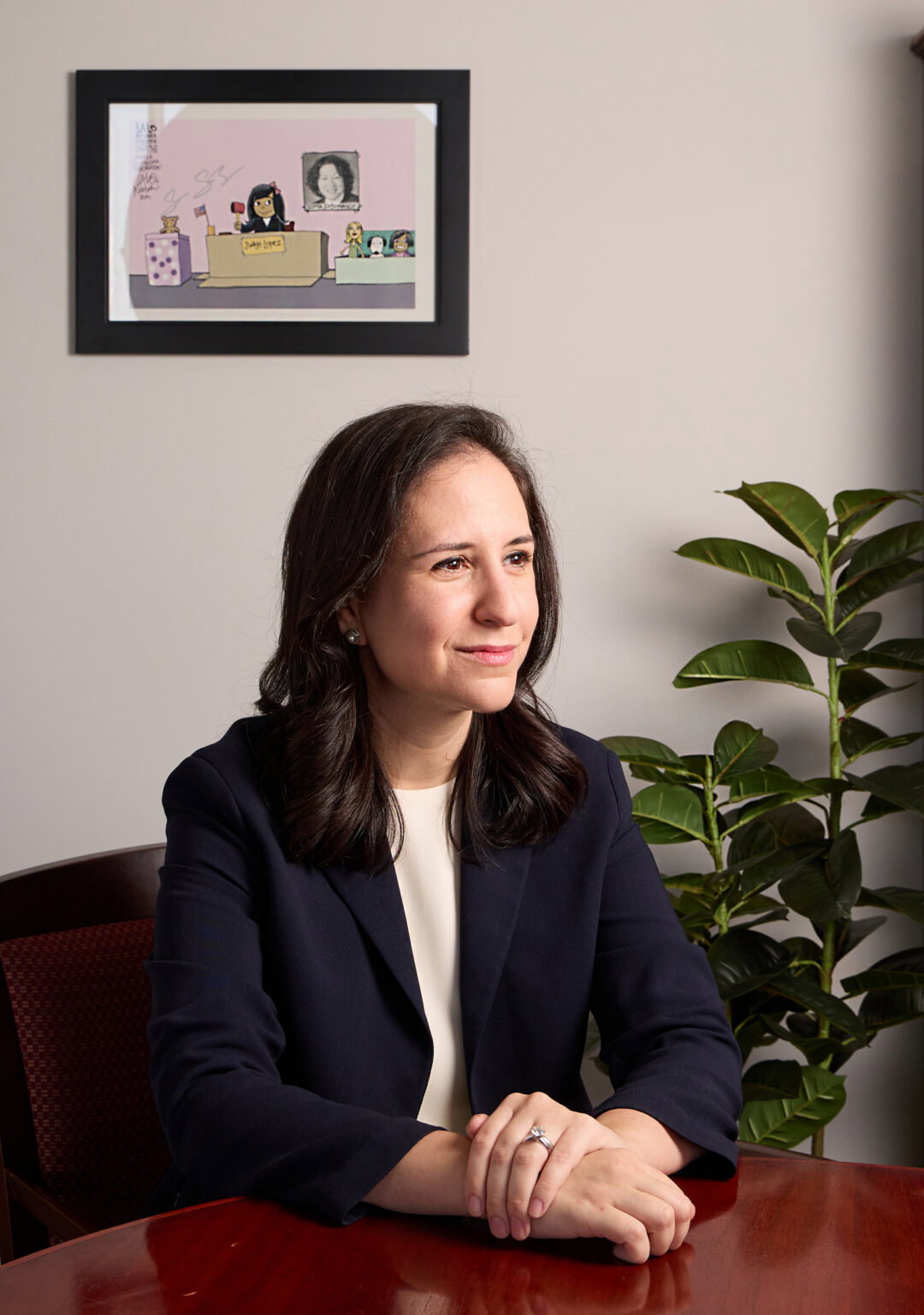
Image: Nicki Evans
She’s seen that visibility about her sexuality and ethnicity as an LGBTQ Latina as both an honor and a responsibility. “When I walk down the street holding my wife’s hand, somebody might see that and might feel a little bit better about themselves—maybe they’ll find their identity, and that’s a superpower,” she says. “If I can make these communities feel a bit more seen—know that this is also their house and they deserve to be here—that’s beautiful.”
Wanting to be versatile and better understand the working world, she graduated from law school at Boston College, then clerked for a Ninth Circuit judge in Montana in 2016. That’s when she got a call asking for her help. “Most lawyers, after they clerk, they take a bar trip. …They relax,” Salinas says, but instead, she joined Hillary Clinton’s campaign in Tampa, leading LGBTQ outreach across Florida and serving as regional field director in Kissimmee.
Heartbroken after Clinton’s loss, she left for Houston, where she joined her current firm, Susman Godfrey. There, she became the second Latina ever to make partner. That’s also where she met her wife, Elizabeth Hadaway. The two married five years ago and are expecting their first child in November.
Though law remains a passion (Salinas is currently working on a major case representing authors, including George R.R. Martin, in a federal copyright class action against OpenAI and Microsoft), she and Hadaway decided it was time to do more after President Donald Trump’s reelection. “I think he won because people didn’t believe in government. … I thought the best way to combat that is by making local government—the government you interact with most—work for people and for people to see that,” she says. City Council felt like the best place to do it, but she didn’t have many expectations. “I just wanted from day one to be making an impact, because this is a special election,” says Salinas. She won the December 2025 runoff with 59.3 percent of the vote, beating opponent Dwight A. Boykins. “We have two years to prove our worth and show that we’re making a difference.”
Since taking office, Salinas says she’s heard Houstonians raise concerns similar to residents everywhere—trash collection, road conditions, infrastructure, ICE cooperation—alongside bigger questions about climate change, affordability, and the city’s dependence on oil and gas.
She’s doing her due diligence to respond—pushing for a worksite safety ordinance for city contractors, modeled on a similar Harris County law; a tenant-protections ordinance addressing eviction and housing standards; and new dumping rules requiring contractors to document their waste and pass a final inspection—already standard in Austin, Dallas, Chicago, and Los Angeles. She feels like progress is being made—even when there’s pushback. “When I came in, everyone told me you can’t pass an immigration ordinance. ‘You can’t try to repair how HPD interacts with ICE,’ and we passed it overwhelmingly with the mayor’s support, all through community coalition building.”
Even with its issues—Houston has the highest poverty rate of any major city—Salinas still believes Houston is the greatest city in America, and its diversity is an asset. “I think we’re at the precipice of all the exciting opportunities and challenges that this country faces because of our diversity,” Salinas says. “We have the opportunity to set the example for the rest of the country on how things should be done, and we have many benefits of being, in some ways, a more affordable city.”

Image: Nicki Evans
But progress and collaboration are hard when parties can’t agree. Salinas says she’s cautiously optimistic heading into the midterms that that could change. With “remarkable candidates” on the ballot, a change in Austin leadership could unlock “sensible” ordinances she says state Republicans have blocked, including one guaranteeing Houstonians the right to water breaks. She references Gov. Greg Abbott’s threat to pull around $150 million in funding over a Houston ordinance protecting immigrants and Fourth Amendment rights and state Republicans stripping the city of control over its own electricity provider—the city’s only remaining power over its grid is approving rate increases, which CenterPoint can ultimately bypass by going straight to the state, she says.
“It’s crazy that we are fighting with the governor of Texas about protecting the Fourth Amendment,” she says. “And that we have no power over the company that controls our power grid because Republicans don’t like Democrats in Houston doing it. That’s got to end. We’ve got to change leadership in Austin.”
Her answers to making noteworthy change in the city depend on two things: thoughtful collaboration and voting. Texas isn’t reliably red in her view—“It’s a non-voting state,” she says, pointing to her own election, when just 43,567 people voted out of the 1.2 million registered. That’s less than 4 percent.
She reminds people that all issues that affect their lives typically show up on the ballot. “When you step outside your door and drive on the street, that’s politics. When you turn on your water faucet—whether the water you drink is safe, whether there’s enough of it—that is all politics. If the school [your child is] going to treats them well, that is all politics,” she says. “We cannot afford to say ‘That is happening over there,’ and remove ourselves from it.”
Vote, she says, and things will change.
|
|
|


