
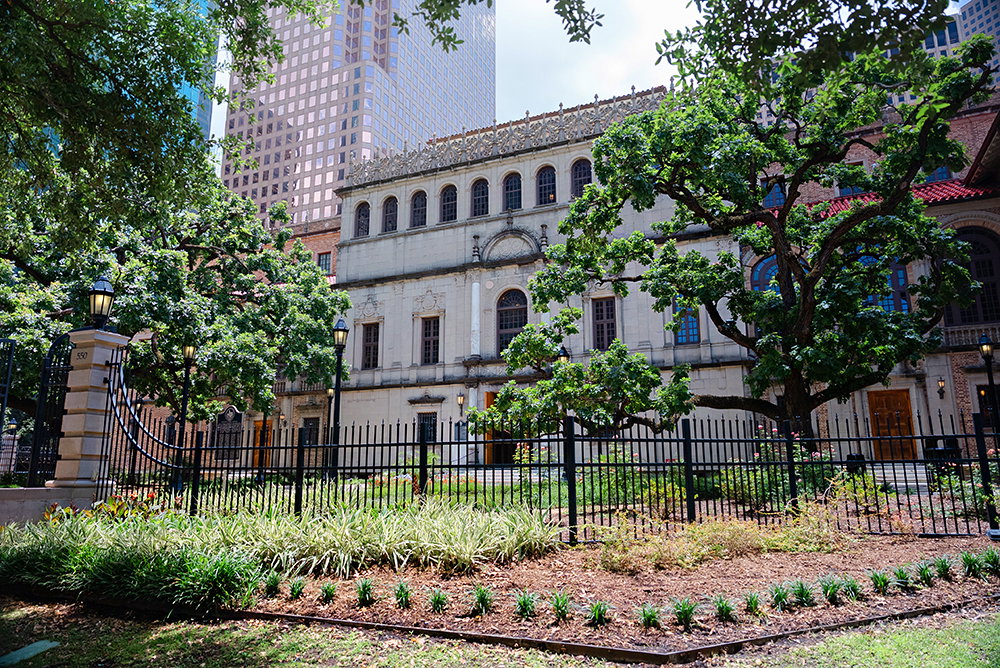
One hundred years ago last month, the Julia Ideson Building opened to the Houston public, steps away from City Hall. It wasn’t called that back then. The striking Spanish Renaissance Revival building once served as the city’s main central library. Ideson, from the beginning, proved herself inseparable from the space’s mission and history during her 42-year career—precisely why Houston City Council honored her with the naming in 1951.
“She was fascinating…the first Texas woman to be in Who’s Who, went over to France during World War I to provide library services,” says Nicholas Sawicki, executive director of the Houston Public Library Foundation. “So, she was really ahead of her time in many ways.”
Decades before the Civil Rights and second-wave feminist movements, Ideson championed education for everyone and the free exchange of ideas among citizens—especially Black and/or female residents. And though she passed before HPL fully integrated in 1953, she continued pushing for the rights, dignity, and free speech of forcibly marginalized Houstonians in her roles as a suffragette and desegregationist. Literature, to her, was one of the grand unifiers, a way to spread knowledge and empathy in a world that even now so often seems to devalue both qualities.
Originally from Nebraska, Ideson’s family moved to Houston in 1892. After attending library school at the University of Texas at Austin, she returned to the Bayou City in 1903 to work as the first librarian at the Houston Lyceum and Carnegie Library. At the time, the library operated out of a McKinney Street mansion previously owned by banker and cotton magnate Thomas M. Bagby; in true Houston fashion, it has since been demolished.
Over more than four decades, Ideson grew the library’s collection from just over 13,000 volumes to a staggering 265,707, and boosted circulation from 60,000 to 600,000. Today, the building bearing her name operates as the Houston History Research Center. It’s still open for public use as part of the library system, next door to the current Central Library building, constructed 50 years after the Ideson Building. Behind its façade of limestone and brick, HPL continues to promote Ideson’s democratic ideals.
“When this building opened in 1926, it was specifically designed…to have that space where people could not only get together, but it also emphasizes the core mission of the library,” Sawicki says. “Learning is not just about the hard material you get… It’s about what you do with that information in conversation with each other, what you do with knowledge in community.”
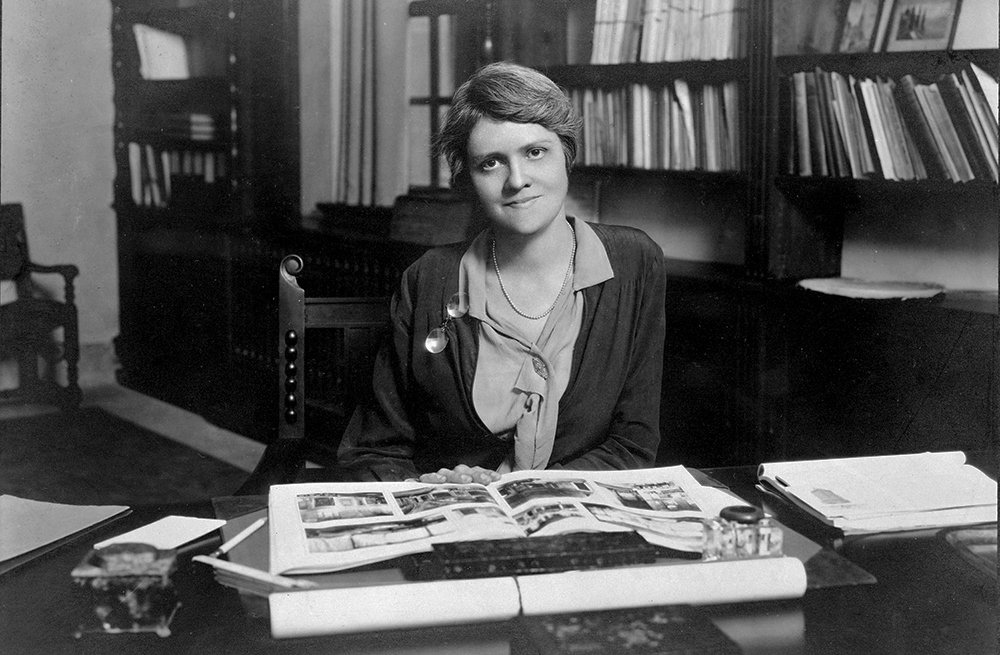
When Boston-based architect Ralph Adams Cram and local architects W.A. Dowdy, J.M. Glover, and William Ward Watkin began designing and constructing what would eventually get dubbed “the Ideson Building,” the librarian received plenty of say in the process. Her input proved invaluable in maximizing Houstonians’ exposure to great literature, fine art, scintillating community discussions, and educational resources through architectural design.
After touring library buildings across the United States, Ideson learned that although she appreciated the artistry, she considered many impractical for day-to-day tasks like shelving or circulating. The structures rarely encouraged visitors to sit and read or talk quietly, leading her to believe that these libraries fit more into a form-over-function mold that served designers and developers more than the people who used them.
“She was really adamant that the Ideson Building be a practical working library building,” says Jim Parsons, programs and communications director at Preservation Houston. Thus, the former central library retains the grandeur of 1920s civic architecture, plus the maneuverability and nimbleness required of an active communal gathering spot: walkways wide enough to accommodate moving carts, and enough places to sit quietly. “It has beautiful spaces in it…but it does not have a grand foyer that’s the size of a football field with a huge marble staircase leading up,” he says. “Because Julia Ideson was like, ‘Well, that’s nice. It’s pretty, but it doesn’t really serve the library.’”
Despite the concessions to practicality, the Ideson Building still stands as a lush work of public art in its own right, sporting a Spanish Renaissance Revival design inside and out. According to Parsons, Mediterranean styles were fashionable in Houston at the time due to a combination of climate and an attempt to establish a more cohesive visual identity at the metropolitan level (original buildings at Rice University and some of the earliest constructs at University of Houston offer examples, too). There’s an auditorium, where ROCO performed this past February in honor of the building’s one hundredth birthday; as well as art galleries; secretly subversive murals by the late Galveston-based painter Angela McDonnell; paintings by Art League Houston organizer (and, according to Sawicki, an alleged nemesis of Claude Monet) Emma Richardson Cherry; a peaceful garden featuring a statue of “mother of Houston” Charlotte Baldwin Allen; and several floors of painstakingly preserved special collections, including Ideson’s own personal archives.
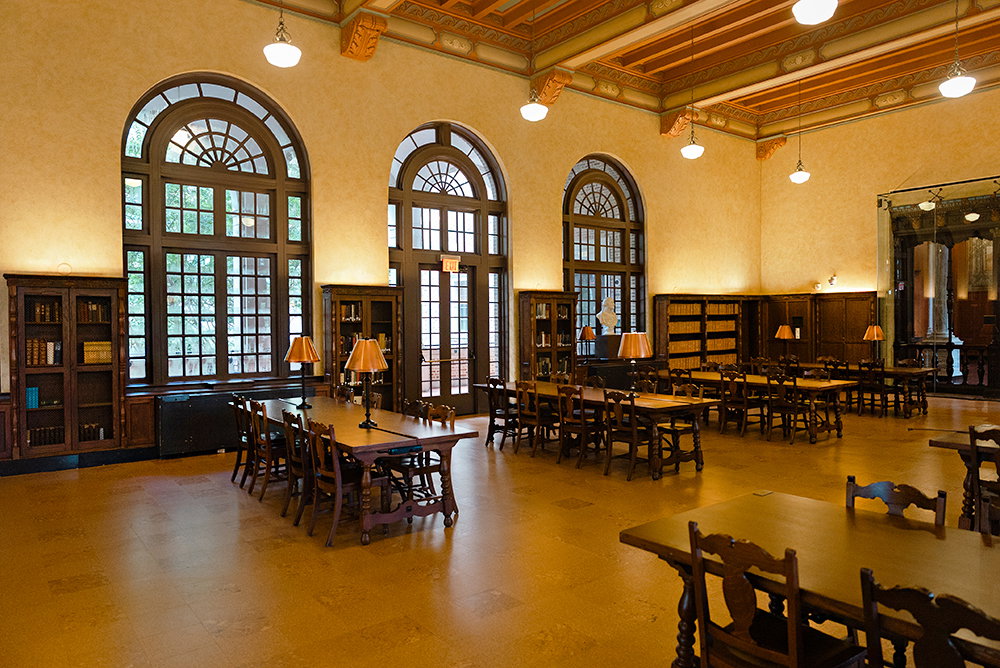
Former reading rooms and circulation areas have been repurposed into exhibition halls with rotating showcases that shine light on Houston history. At press time, the most recent exhibits on view center on Rice University’s Latin American legacy and historic maps of Houston neighborhoods, and display cases throughout the Ideson Building cover the eponymous woman’s legacy and influence on HPL. But one of the crowning glories is the main reading room.
Home to rare tomes, bronze busts of long-dead men, and a reproduction of the Venus de Milo bought in 1903, this free forum for studying, reading, and whispered conversations is open to all Houstonians. Reading Rainbow host Mychal Threets made a stop here in July for a charming Q&A about his life spent promoting literacy and social justice, not unlike Ideson during her lifetime.
Today, the room echoes with the footsteps of the present reverberating off reminders of the past. While the Ideson Building’s functions have changed due to HPL’s expansion and shifting community needs, the spirit of the expansive space—of inquiry, of connection, of learning—remains the same as it ever was. “This is a gorgeous building. It really is,” Sawicki says. “There is a value in making a beautiful thing for the public, and something that we all own and share together. We share a piece of beauty together.”
|
|
|