
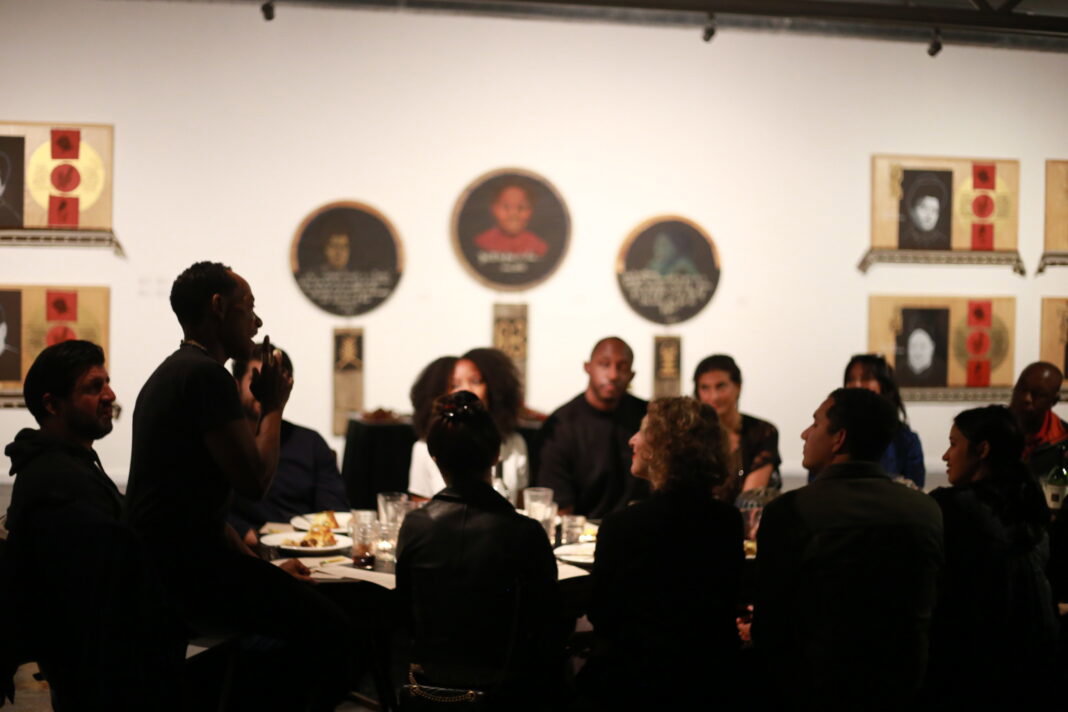

The best dinner parties don’t start with the menu. They start with the guest list. Marlon Hall, a Houston cultural anthropologist and artist, has hosted more than 300 dinners since 2016, and the food is rarely the point. Strangers sit down, skip the small talk, and leave knowing one another in ways some friends never manage. His method fits into a few rules, and you can borrow them for your next gathering. Here’s how to host a dinner worth remembering, Hall-style.
Build your guest list like a bouquet.
Hall doesn’t invite people who already run in the same circles—no table of just gym buddies or soccer moms. He thinks of a guest list the way you’d think of flowers: dandelions next to sunflowers next to whatever else catches your eye. The more varied the bouquet, the more interesting the table. “When I think about guest lists for my dinner parties, I not only think about who I know that should know each other, but I’m always curious as to what can people know more about themselves through interactions with strangers,” he says. “When we start having a conversation with somebody who’s different than us, and we recognize how similar we are at the core, it just deepens our core. It just drives us deeper into the core of who we are.”
Leave work at the door.
The one non-negotiable rule: no talking about what anyone does for a living—only “who they are for a life.” This means no business cards and no networking. Just who people are, told through vulnerability-driven stories.

Incorporate quotes.
Lay out a handful of quotes, two copies of each, and let guests choose the one that “chooses them.” Seat people together only if they picked the same quote. The conversation, Hall says, always finds its way to what the quote-sharers have in common, not what sets them apart.
Trade artifacts.
Ask guests to bring a pocket-sized object that carries a piece of their family history. Midway through dinner, have pairs exchange them and discuss them while holding each other’s story in their hands.
End on a four-word story.
Inspired by the six-word story often attributed to author Ernest Hemingway (“For sale: baby shoes, never worn”), Hall asks guests to write a four-word story made up of a verb, a noun, a preposition, and a noun, and address it to the future of the world. Guests write one alone, then the table writes one together. Hosts can make their own rules.
Published in the Set the Table issue of Houstonia Magazine.
|
|
|