

It’s an uncommonly gorgeous spring evening: the perfect midpoint between warm and cool, rain temporarily abated, the sky watercolored in cotton-candy hues. My friends and I want to take advantage of it, walking the half mile between my Montrose condo and an event at the University of St. Thomas—a pleasant trip if the weather doesn’t suck and drivers at Montrose and West Alabama behave.
Among us is Texas City–based musician and actor Ladybird Luker, an ambulatory wheelchair user who goes by the stage name “Ladybird.” They could meet us there and park at the school, where the facilities are compliant with the Americans with Disabilities Act (ADA). Instead, they choose to spend time with us outside, enjoying the weather and testing out their new power chair.
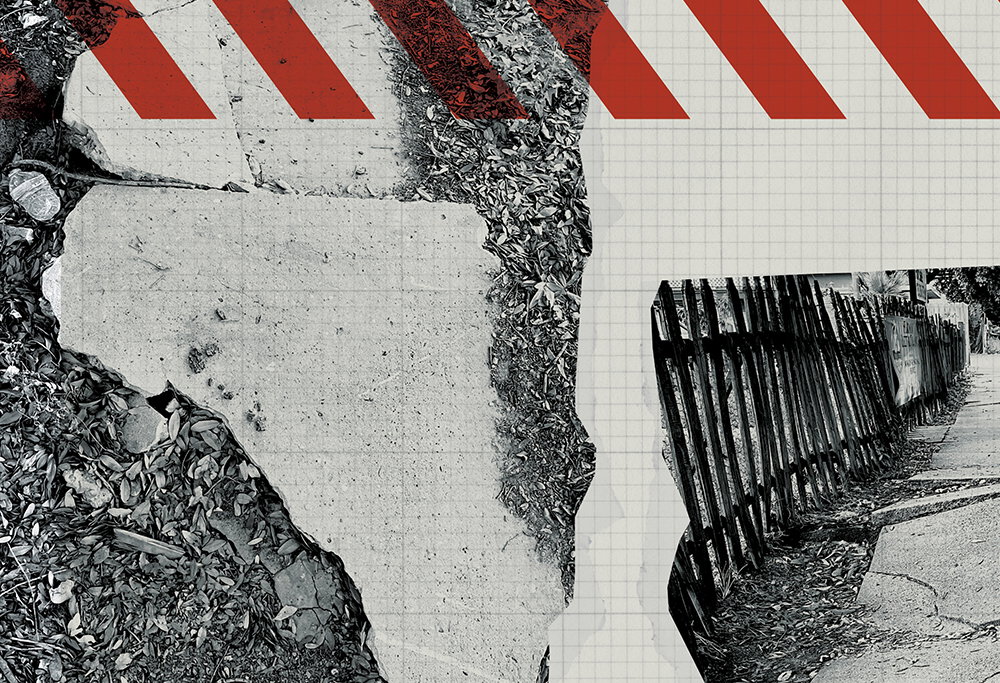
On our route, Ladybird encounters a ramp submerged in draining water and missing chunks of sidewalk along West Alabama, where new construction always seems to pop up. Cracks, gaps, and splits. Tree roots arching up so high they create tiny hills amid a swampland notorious for its flatness. Each time, our group separates. A few friends help guide Ladybird’s wheelchair over the obstacles. A couple of us keep them steady on their feet until we hit firmer ground.
We don’t mind. It’s what you do when you love someone the way we love Ladybird, with their electric-blue hair, deliciously dark humor, and playful songs about hand-holding skeletons and bisexual panic. But in their interview for this article, they admit they would not have been comfortable without us, even though independent travel is the whole point of having a power chair.
This moment represents only 20 minutes of Ladybird’s daily life and experiences of being a physically disabled person in the Houston area. “It feels so hopeless,” they say. “The default in America is ableism. It’s so challenging.”
The struggles aren’t restricted to sidewalks. Ladybird is often forced to limit their career opportunities, performing only on the few stages they can access, which means they don’t book shows in Houston as often as they’d like; Galveston is comparatively easier, but not ideal, either. Investing in their own portable wheelchair ramp also didn’t offer a one-size-fits-all solution. Physical obstacles, including inaccessible housing, are pervasive, as are rising medical expenses, insurance issues such as denials and deferrals, and the fact that disabled people may receive less Supplemental Security Income if they get married.
Mary Kathryn LeMaster, a legally blind author, wellness coach, and feng shui consultant who also assists businesses with ADA compliance, shares Ladybird’s frustrations. When she’s out walking, she relies on her cane and audio signals to know when it’s safe to use the crosswalk. Many of those signals break down and aren’t repaired right away, particularly in her Garden Oaks neighborhood, she says. Even when the sidewalk is free of obstructions, LeMaster still can’t fully navigate public infrastructure without pedestrian cues. Sometimes, she steps off a curb, only to land in a pothole that could cause injury.
“I had no idea what accessibility even really meant. I had no concept of it until I started using a cane,” LeMaster says. “My cane would get caught in so many cracks. And when it gets caught, then it jabs me in the stomach.”
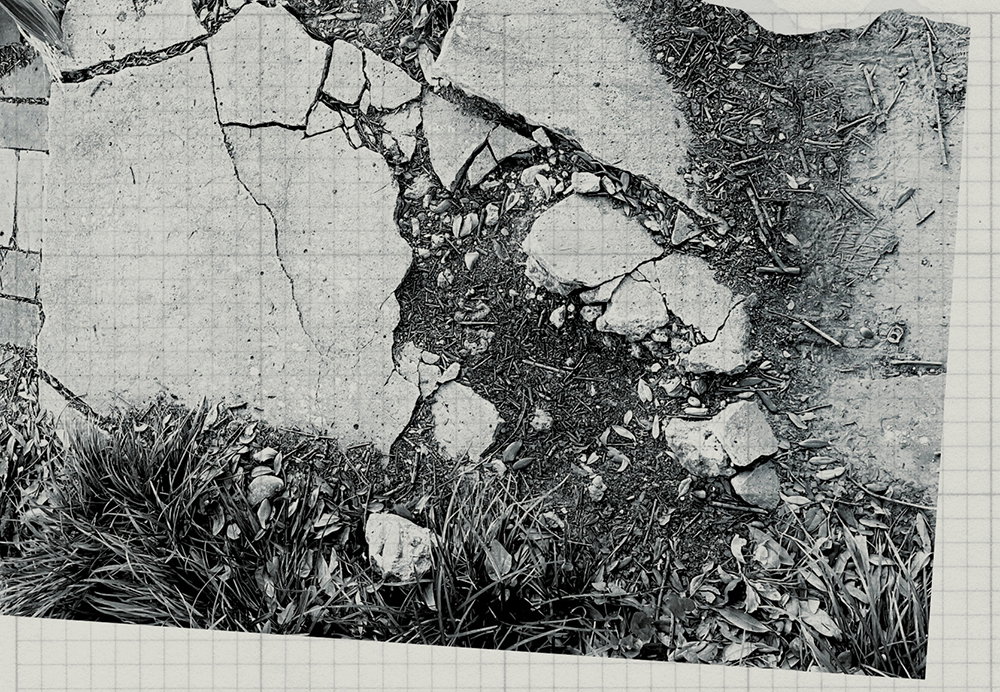
Houston’s very bones break and decay, forming hostile terrain that challenges even the able-bodied. For individuals with a disability, this entropy stokes alienation from public life and reduces economic opportunities. In our many conversations over the years, Ladybird has emphasized how inaccessibility renders disabled people invisible in their own communities. The ADA requires public facilities and businesses to be accessible—think curb cuts and ramps for wheelchair users or large-print menus for the visually impaired. In practice, that doesn’t always happen. The onus of finding and reporting ADA violations so often falls on disabled people themselves, and many say standing up for their rights can feel like a full-time job. “I’m not the first, I’m not the last, and we need help,” Ladybird says. “We are so tired of fighting.”
Walking the Walk
That many of Houston’s sidewalks resemble ancient Greek ruins isn’t exactly breaking news. Urbanists, concerned residents, politicians, and journalists have comprehensively documented the problem, yet it persists.
Houston Chronicle’s Matt Zdun reported in 2024 that only 61 percent of the city’s sidewalks achieved the highest rating of “good,” according to the most recent survey from Houston’s Public Works. He identified around 152 miles of “sidewalk islands” citywide, which he defines as “segments that are substantially disconnected from the main sidewalk network.”
Still, merely reading about the widespread, long-running damage doesn’t fully prepare anyone for how dangerous a simple walk in Houston can be. Trip-and-fall hazards, narrow spaces next to aggressive drivers, occluded views, and disconnected paths are common sights, sometimes all at once.
Urban Paths founder Laura Conely and I meet up at Lebanese bakery We’re-Dough one summer morning, loading up on caffeine and carbohydrates before exploring. I’d asked her to choose stretches of sidewalk she believes are most dangerous for disabled pedestrians. She’s been leading walks around the city for 15 years, promoting wellness, civic pride, public art appreciation, and a greater sense of community (LeMaster sometimes joins her). It’s given Conely a unique perspective on the state of the sidewalks, and she uses it to encourage safer streets. Today, she guides me along Westheimer Road, near where Hillcroft Avenue becomes Voss Road.
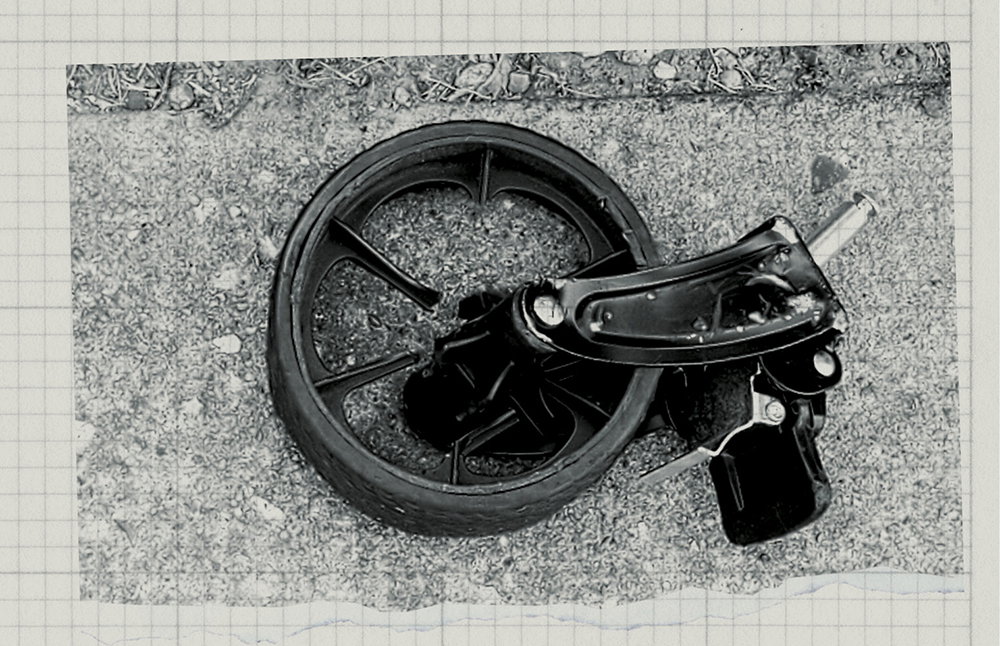
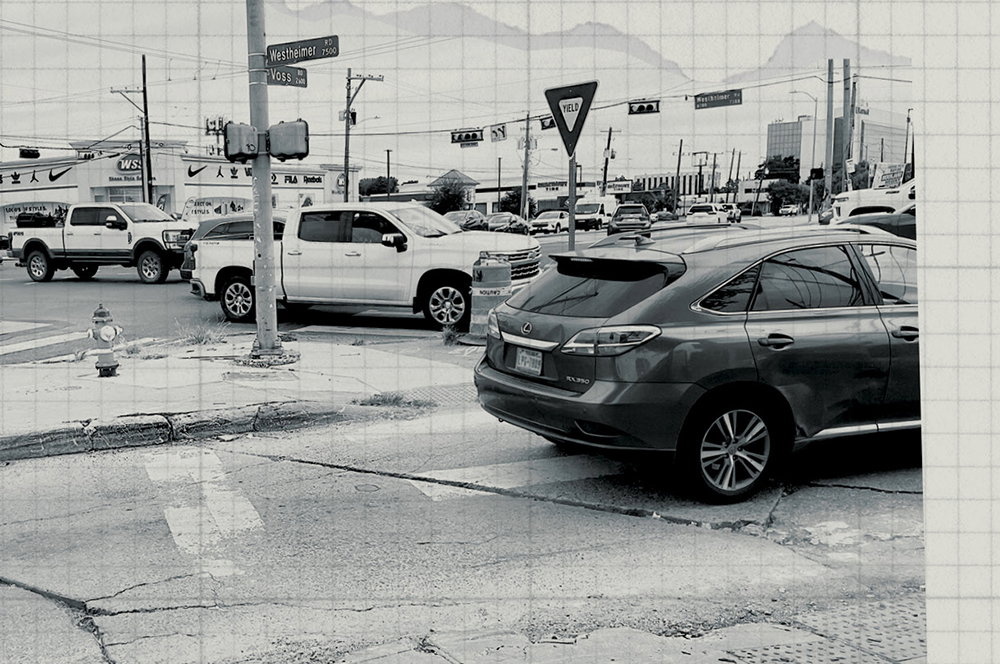
Less than an hour and a mile in, Conely points out several glaring ADA violations: wide gaps, cracks that create uneven surfaces, asphalt blobs on the curbs, insufficient buffers between cars and sidewalks, missing or inadequate curb cuts, and “sidewalks to nowhere” that stop at patches of grass. In some areas, there’s roughly half a mile between crosswalks, leaving few options for reaching a safer route. At Westheimer and Voss, we find what appears to be the broken front wheel of a wheelchair.
Just off Westheimer and Marilee Lane, a part of the sidewalk in front of an apartment complex is barely wider than our feet put together; Conely jokingly walks across it like a balance beam. On the tail end of our circuit, a massive bush blocks our view of the crosswalk. It’s our turn to walk, but a car making a right turn doesn’t notice us. The driver brakes quickly, and the driver behind them doesn’t take that well. They honk at us the entire time we cross the street.
Despite her outspoken advocacy for pedestrian safety, public transportation, and more ADA-friendly infrastructure, Conely says she isn’t an “anti-car activist.” The truth is, she loves cars. She owns three, including a Winnebago doubling as a mobile office. But telling people to drive everywhere instead can’t be the solution when not everyone can physically operate a motor vehicle, she says. Public transportation, too, has its limits when the disabled people it carries can’t safely navigate the sidewalks to their destinations.
Even with so much exposure to flawed infrastructure, she still describes herself as an optimist. Her work with Urban Paths promotes the idea that “wherever we are, there’s beauty”—that all Houstonians have the right to get outside and experience the same small joys we shared that day: discarded cicada carapaces in exquisite condition, smooth tree bark, and buttery smells from nearby bakeries. “We want to be out here seeing life, nature…engaging our senses,” Conely says. “We want to be in the world. We can’t be isolated inside cars and inside houses. It’s really bad for us as individuals. It’s bad for community. It’s bad for family. It’s just bad, bad, bad, bad.”
But how does Houston move on from its “bad” habits and become a city where everyone, regardless of ability, feels welcome and included? As with many bureaucratic inevitabilities, it depends on whom you ask. There’s a high chance they’ll tell you to ask someone else.
…And the Law Won
Residents often cite Montrose, the Museum District, and Denver Harbor as especially egregious in terms of accessibility, but Chronicle’s 2024 report shows that nearly every neighborhood has some degree of inaccessibility. El Dorado/Oates Prairie in northeast Houston has the highest concentration of poorly rated sidewalks, at 21 percent.
Chronicle’s Pulitzer-winning deputy opinion editor Raj Mankad, who generously shared his 2016 focus-group research with Houstonia, spoke with disabled residents about their experiences with public infrastructure such as sidewalks, streets, and public transportation. “People with disabilities face a variety of barriers that would not be in place if 20-year-old ADA standards were followed,” he wrote in his findings.
Failure to meet these standards prevents Houstonians with disabilities from feeling like integral members of the community while actively infringing on their civil rights. In 2014, the US Department of Justice found the Harris County Clerk’s Office violated the ADA; only a third of the county’s 86 polling places surveyed during the 2013 election cycle had adequate parking, ramps, and other infrastructure for disabled voters. Sidewalks, unsurprisingly, were among the barriers cited. The Justice Department sued the county, and a 2019 settlement required it to audit its polling centers and implement “policies, practices, and procedures to bring its voting program into compliance with the ADA.” This included curbside voting options, staff training, and routine compliance reports.
On the surface, the solution to more inclusive pedestrian mobility seems simple: Just fix the damn sidewalks. But the reality is more complex. The City of Houston cites property owners as responsible for repairs in its Code of Ordinances, but suburbs operate under different guidelines, which can create confusion. For example, in Katy, the city is responsible for sidewalks outside private roads or gated communities. Sugar Land Public Works maintains sidewalks within public rights-of-way. The same goes for Conroe, though homeowners’ groups, utility districts, and the Texas Department of Transportation hold responsibility elsewhere.
André Gaston, principal attorney at Gaston, LLP, handles civil rights cases including ADA violations. He notes that the ADA regulates government properties and public-facing private businesses under federal law, and that suing a municipality like Houston under the ADA involves various legal hurdles and red tape. There isn’t much case law on municipal liability either, he says.
Gaston also warns that ADA cases aren’t always easy to win. Even when a business is held accountable, it can take years for it to finally fix the accessibility issue. Ladybird found this out when filing a complaint against a Clear Lake shop selling Sanrio and K-pop merchandise. The elevator had been broken for about a year, and it took several more years to finally get it fixed. According to Ladybird, the case was ultimately handled through third-party mediation, avoiding court entirely.
It also doesn’t help that the city’s sidewalk rules keep shifting. In 2023, City Council created a fee that lets qualifying property owners pay into a Sidewalk Fund instead of building a sidewalk. The next year, Mayor John Whitmire directed officials to waive the sidewalk requirement for new homes when building one would be “technically infeasible” or result in a sidewalk to nowhere. Only the Planning and Development Department can determine which homes or property owners qualify. Mayor Whitmire’s office did not respond to Houstonia’s requests for comment.
At-Large Position 5 City Councilmember Sallie Alcorn, who created the Sidewalk Technical Advisory Group in 2023, opposed the ordinance amendments. She’d like to see a sidewalk bond on the ballot to help offset some or all of property owners’ repair costs. During the late mayor Sylvester Turner’s administration, Alcorn says there was interest in such a bond, but the planning department found it would cost the city $13 billion to absorb full responsibility for sidewalks. She predicts that future bonds will require a different scope, or sidewalks will need to be folded into a more general bond.
Although repairs legally fall on property owners, the city still has options to help. Run by the Office for People with Disabilities (OPD), the Pedestrian Accessibility Review Program improves up to 1,500 feet of requested sidewalk or pathway to ensure residents with mobility, blindness, or low-vision disabilities have an accessible route to “essential destinations,” including their homes, grocery stores, banks, parks, bus stops, and medical facilities. The city’s School Sidewalk Program similarly builds sidewalks for up to four blocks leading up to existing schools. And if a property abuts a major thoroughfare, the city repairs up to four blocks of sidewalk under the Major Thoroughfare Program, which requires approval from the Houston Planning Commission.
Still, Alcorn says her neighbors continue to ask her when the city will fix their sidewalks. The public doesn’t always understand that city law holds property owners responsible for repairs, and disabled people don’t always have the time or energy to address every individual accessibility problem they encounter. Ladybird and LeMaster both describe how exhausting it is to constantly advocate for their most basic civil rights.
“I’m not sure that the people who are affected by the breaking sidewalks are as vociferous as drivers, and therefore a lot of the sidewalks are not maintained the way they should be,” says Lex Frieden, a wheelchair user and a groundbreaking activist in the disability rights space who provided a pivotal voice when Congress passed the ADA in 1990. The UTHealth Houston physical medicine and rehabilitation professor also served as chairperson of the National Council on Disability for President George W. Bush. “What’s important for people to know is that one little gap, one crack, one missing piece in a sidewalk for me…might as well be a wall,” he says.
But the city hasn’t done as poorly as some might think, adds Frieden. He’s personally had luck reporting sidewalk problems near his home and the Medical Center—all of which the city promptly addressed. “The Mayor’s Office for People with Disabilities has been largely responsible for helping a lot of people get around…but it’s not going to solve the kind of institutional problem that we have when we’re building new strips of sidewalk, new roads, or when we’re repairing streets but not the sidewalks,” he says. “That’s where we need more consistency.”
LeMaster’s experience with OPD has not proven as fruitful. She says she’s encountered “so many loopholes just to get to the real conversation that’s going to make the change.” OPD was unable to schedule an interview with Houstonia by press time.
Similar disappointments surfaced for LeMaster while working as an ADA compliance consultant. Her clients—most based in Colorado and Montana—tended to resist her suggestions, usually citing cost as their reason for not investing in the well-being of disabled patrons. None of the 20 or so Houston businesses she contacted were interested. She’s currently taking a break due to burnout.
“I’m so angry at so many businesses. They just don’t care,” LeMaster says. “They just literally do not want to put the forethought into it and create more accessibility.”
Where the Sidewalks Lead
Money sits at the root of most accessibility concerns. In Houston, funding for sidewalk repairs comes from a combination of sources, including Council District Service Fund (CDSF) holdings, Tax Increment Reinvestment Zones (TIRZ), federal funds, and fees from property owners who choose not to make repairs. Alcorn says that about 70 percent of these fees stay in the neighborhoods where they’re paid, while the remaining 30 percent goes to other parts of Houston that need it.
Progress can be slow, creating the illusion of inertia, if not outright apathy. But progress is, at least, getting made in some areas. This past April, US Rep. Lizzie Fletcher (D-Houston) announced she secured $850,000 in federal funding to close critical sidewalk gaps in northeast Montrose. In an emailed statement to Houstonia, Fletcher detailed her work to make neighborhood sidewalks and roads “friendlier and safer” for everyone, as well as her goal to designate additional money toward Montrose’s southwest quadrant.
Montrose TIRZ also recently moved its West Alabama Reconstruction Project into the design phase, incorporating community input on how best to create safer pedestrian spaces between Midtown and Upper Kirby. In a November 18 newsletter, the district announced that its Mandell Street Improvements project will begin in December, with one major aim being ADA-accessible sidewalks. The Memorial Heights Redevelopment Authority, which oversees TIRZ 5, is repairing and building out new sidewalks as part of the second phase of the Shepherd Durham Project—an initiative important to nearby residents. A study featured in the 2026 Greater Heights Strategic Connections Plan showed that prioritizing safer crossings and closing sidewalk gaps are major community goals.
However, neighborhoods that receive repair funding aren’t always the ones that need it most. Low-income Latin American and Black neighborhoods are the most likely to have poorly ranked sidewalks, and some have both gained and lost the money needed for necessary upgrades. Alcorn cites the 2023 Gulfton & Kashmere Gardens Resilient Sidewalks Project as an example: $43 million in federal funding was approved before the Trump administration rescinded it.
“So, you have these different areas throughout town where disabled people can go? … That’s bullshit,” LeMaster says. “Do not segregate us to one area and make that the only accessible place in the city.” There’s already a model that can address this disparity. In 2020, the city’s Planning and Development Department launched Livable Places, which incentivizes developers to make infrastructure changes to accommodate people traveling on foot, by wheelchair, or by bike.
District C Councilmember Joe Panzarella’s 2026 campaign platform leaned heavily on pedestrian advocacy in the parts of Montrose, Greater Heights, Oak Forest, River Oaks, Midtown, Meyerland, and Braeswood that he represents. At his 100 Days Town Hall event this past September, most respondents in a funding-related survey ranked walkability improvements as their top priority, followed by street improvements. Many also stated that missing and damaged sidewalks and unsafe streets were the biggest challenges in their neighborhoods.
Even before survey results went public, Panzarella said he planned to use his CDSF—money set aside for community service, neighborhood issues, and infrastructure repairs—to “connect neighborhoods to the already existing hundreds of miles of bayou bike trails.” It’s a move that he says will benefit Houstonians of all abilities who need or want to navigate the city without a car. “Bayou Greenways trails, to me, are just truly above and beyond infrastructure,” he says. “The sidewalks throughout Montrose, throughout the Heights, should reflect the type of quality that we see in bayou bike trails as well.”
And on September 30, Panzarella announced on Instagram that City Council approved $2.5 million for safety improvements along Waugh Drive and South Heights Boulevard, including sidewalks, traffic signals, and crosswalks.
But it isn’t just the sidewalks. It’s never, ever just the sidewalks. Disabled Houstonians deserve the full range of basic human rights, which requires close attention in multiple areas. ADA-compliant walkways make for a good start. Until Houston gets there, Ladybird stresses that support from able-bodied peers is crucial to help better understand and build a world that everyone can access.
“‘Adopt’ a disabled person for a day,” they say, adding that it can help others see the obstacles they face daily. “Even that helps the community. It doesn’t seem like it, but if a ‘normal’ person wants to…that is a great step.”
Know Your Rights, Report the Problem
Houston’s sidewalks and public spaces aren’t always accessible, but there are ways to push for change. Here’s where to start.
– ADA complaints against business owners or local governments can be filed directly with the US Department of Justice.
– Residents can submit information about broken sidewalks to the Pedestrian Accessibility Review Program.
– Applications for the School Sidewalk and Major Thoroughfare programs can be filed online through Houston Public Works.
Published in the Set the Table issue of Houstonia Magazine.
|
|
|