Living in the Sprawl: What Counts as Houston?

Image: Anthony Rathbun
“Oh, you’re from Houston? What part?” Houstonians love to quiz each other on their geography, as if proving their ties to the city. And who can blame us? Inside the Loop or out, Northside or Southside, Houston proper or “Greater Houston”—the answers aren’t always straightforward. Add in the claims that our hometown stretches from Kingwood to Fulshear, and the question becomes harder to answer.
In the past few years alone, Houston has grown rapidly, with new housing pushing the city limits outward. According to Rice University’s Kinder Institute for Urban Research, Houston’s metropolitan area grew by 63 percent from 1997 to 2017, with boundaries extending as far as the NASA Space Center near Clear Lake, George Bush Intercontinental Airport by Humble, and even the Energy Corridor. In total, that’s around 667 square miles. Here’s where it gets confusing: Areas like Spring Branch and Kingwood, often assumed to be suburbs, are included in Houston’s jurisdiction, but others, like West University Place and Bellaire, fully within the famous 610 Loop, remain independent cities. And every few years, a new suburb or master-planned community like Bridgeland emerges, sparking debate over whether it “counts” as Houston. As Space City expands, questions about its borders get even hazier. When the sprawl is all we know, how do Houstonians define Houston?
Local entrepreneur KB Brown, the self-proclaimed “mayor of Montrose,” offers a simple litmus test: Check your mail. If the address includes “Houston, TX,” then you’re in luck. “But if that second and third line says a different city—Katy, Cypress—guess where you don’t live, friend?” Jurisdiction matters, too; if HPD doesn’t patrol your neighborhood, Brown argues, you really don’t live in Houston.
City council candidate and urbanist Jordan Thomas draws the line at highways: The perfect version of Houston would be within the 610 Loop, with suburbia beginning past Beltway 8, and transportation infrastructure efficiently connecting the two. “Once you go outside Beltway 8, that’s Dallas,” Thomas jokes. Even so, the Houston city limits are not as clean-cut as a mailing address or highways.
Dalia Munenzon, an assistant professor of urban design, sustainable communities, and infrastructure at the University of Houston, says the city’s blurred borders don’t really provide a succinct answer. “I think it’s a subjective definition,” Munenzon admits. Municipal limits, zip codes, and census data provide technical and physical borders, but in practice people draw their own mental maps—sometimes by community, sometimes by cultural landmarks or “physical anchors” like highways, or even by commute time or distance. For one person, a 30-minute drive on the freeway counts as Houston, but go just 15 minutes farther, and that’s considered a reach.

Image: Anthony Rathbun
Still, Munenzon says Houston doesn’t quite fit the definitions of an “urban city.” Urbanist Cedric Price’s City as an Egg theory compares major, older cities like London, Paris, and New York City to fried eggs, with one dense center (the yolk) surrounded by the suburbs (egg whites). Houston, by contrast, would be scrambled. “You have multiple centers that are feeding into their communities,” Munenzon says. “You have people who are coming from different religions, cultures, and they all live around their own centers.” Think of Aldine, Asiatown, Gulfton, the Mahatma Gandhi District, and Westchase—each a hub, stitched together by highways, unencumbered by landmarks like oceans or mountains, and ripe for growth.
Sprawl is nothing new for Houston. Some of its best-known neighborhoods
began as suburbs before they were absorbed into the city proper, says Brian Riedel, associate director of Rice University’s Center for the Study of Women, Gender, and Sexuality. “What made Montrose amazingly well-known was that it was not a gayborhood at the beginning,” Riedel says. “It was an elite suburb.”
Riedel, who maps Montrose’s history, says the neighborhood was planned in
the early 1900s as an elite enclave of deed-restricted mansions and detached homes for white, upper-middle-class families, a retreat from the “dirty urban core” of Downtown. “Part of it was outside the city limits when it was founded, but it’s changed over time,” he says. “And that’s going to be the case here with almost all of these neighborhoods, right?”

Image: hector sanchez
Now, Montrose is considered part of Houston’s urban cultural core and one of its most recognizable enclaves that’s famous even outside of Texas, says Riedel, who likens it to New York City’s Greenwich Village. Similar stories have played out elsewhere, with other periphery suburbs swept up into Houston’s boundaries. Oak Forest and Kingwood were sucked into the city. And though distinctly their own, suburbs like Deer Park, Humble, and Katy are still colloquially claimed as “Houston.” Meanwhile, the opposite happened for “pocket cities” like Bellaire, West University Place, and Bunker Hill Village, Riedel explains. Rather than being absorbed, Riedel says these cities chose independence, providing their own water, trash, and police services.
The city’s absence of zoning laws, which determine how land can be used, has played a part, according to urbanists. Houston voters rejected zoning three times (in 1948, 1962, and 1993), allowing developers more freedom, which resulted in a unique, sometimes contentious city landscape. “You can get some really weird, wacky development, like a strip mall next to a strip club, next to a preschool,” says Thomas.
That flexibility also has trade-offs. “Houston, in a way, is a lab or experimental space for no zoning,” says Munenzon. “It allows this…let’s say, affordability, perhaps for younger people who want to live in smaller apartments, but closer to Downtown or Montrose.” Developers can build housing in expensive areas, which may drive down costs by creating a greater housing stock, but zoning can be “extremely restrictive,” with limited development.
Scholars who continue to study Houston’s evolution also say the lack of zoning has exacerbated issues like soil contamination, air pollution, and other health concerns near communities. Policies like deed restrictions and nuisance laws have provided some structure, challenging developers and shaping “flexible neighborhood evolution,” but Houston remains an outlier compared to most US metro areas.
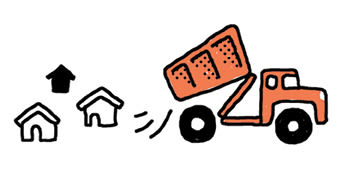
Image: hector sanchez
Deepa Ramaswamy, assistant professor of architecture and urbanism at UH, says the lack of zoning has created high density that contributes to the sprawl that makes defining the city difficult. Even the concept of “suburb” doesn’t apply neatly. Unlike the image that evolved from the nineteenth-century British definition of suburb—the upper middle class living beyond the city in single-family homes—Houston’s suburbs are denser, more diverse, occasionally self-sufficient, less clearly separated from the urban core, and sometimes just plain confusing. “Houston’s uniqueness comes because, I feel a lot of these typical definitions for [urbanism]—what is urban, what is suburban, what is periphery,
what is core, what makes something urban or citylike?—Houston kind of questions all those binaries,” Ramaswamy says.
So, what is Houston, really? A fried egg gone scrambled. A sprawling city where Montrose was once a suburb and Katy is sometimes claimed as part of Houston. A place where limits are constantly shifting and stretched beyond our own understanding.
As the saying goes, Houston may indeed feel like it’s an hour away from Houston, but many residents embrace it. We still love it for what it is. As KB Brown puts it, “It’s all good. The bigger we seem, the better we seem.”