A Tiki Island Waterfront Home Built for Health and Hurricane Resilience
From the water, Dr. Steven and Trudy Rea’s Tiki Island home looks like a Gulf Coast dream—clean-lined architecture, a metal roof built to withstand a storm, and a view that feels cinematic. But beyond the 4,000 square feet of sunlit living space lies something less visible: a house designed not just for beauty, but for health.
The Reas first purchased the home when Steven was in medical school at UTMB, holding onto it for years while living and raising their five children in Midland. When they decided to return to the Houston-Galveston area, they chose to demolish their older Tiki Island home and replace it with something new and intentional.
The completely revamped four-bedroom, five-bathroom waterfront home now features an expansive outdoor area and beautiful views of the water, but one of its most intriguing and understated features is its emphasis on health-conscious materials, furnishings, and finishes.
The Reas wanted to factor in their well-being: Two of their children have been diagnosed with celiac disease, and the entire family is conscious about nutrition. Naturally, the kitchen became an important investment. “From the time we get up until we go to bed, we cook in that kitchen,” Trudy Rea says.
Interior designers Melanie Hamel and Marie Flanigan of Marie Flanigan Interiors understood that the house needed to be as functional as it was beautiful, Trudy says. They had wood flooring options evaluated for formaldehyde. The HVAC system was optimized to improve air quality, and the electrical wiring was shielded to reduce electromagnetic fields. Sheetrock was minimized as much as possible and finished with plaster to reduce volatile organic compounds that can off-gas (release chemicals from manufactured materials such as furniture, paint, carpet, and electronics) for months.

Even weather resilience was approached holistically. In addition to selecting windows and a metal roof capable of withstanding a Category 4 hurricane, the Reas worked with designers to choose exterior and roof colors to avoid heat buildup that could deter birds and other wildlife. “One of the things I remember about our first meeting was that the house was on a migratory path of pelicans,” Flanigan says. “They were very thoughtful about this house.”
What once felt niche has become more common. Since the height of the COVID pandemic, Hamel and Flanigan say vendors have been more mindful of healthy home products and are sourcing furnishings with lower environmental and health risks from companies such as furniture manufacturers Hickory Chair and Lee Industries.
“At the time, ‘healthy home’ was top of mind for vendors. Companies were forthcoming about the materials they used, especially with fabrics,” Flanigan says.
For the Reas, that meant Hamel and Flanigan had to learn more about what’s in the physical materials. “We asked about the foam and adhesives they used in upholstered pieces, and we asked about off-gassing. We got things early so they could off-gas while in storage,” Flanigan adds.
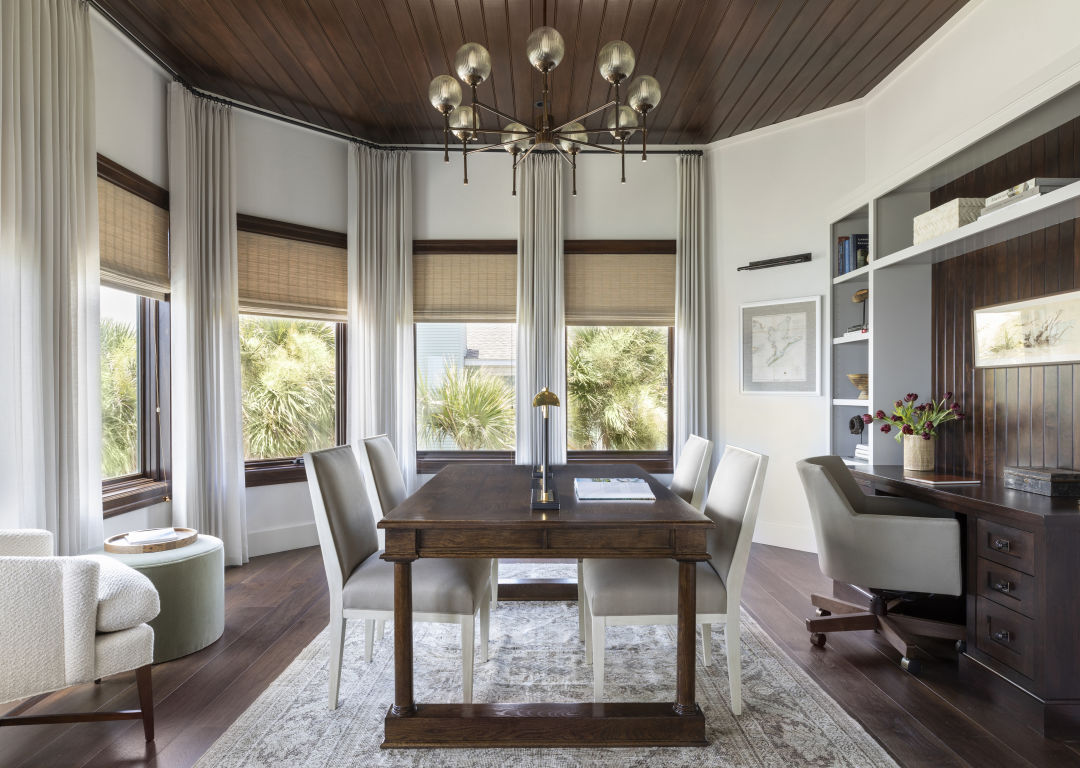
Wellness was also considered in the floor plan. The main living area features a double-sided fireplace that anchors the living and dining areas. Across the room, an office offers a relatively quiet place for the children to study. A grand piano occupies one corner, waiting to be played, and a nearby console holds a TV that tucks away out of sight when not in use.
Natural stone floor tile, walnut cabinets, and stainless steel and brass accents combine in the kitchen, where open shelves store pots and pans and invite in natural light and views of the water. A small banquette at a breakfast table creates a casual space for meals or family conversation while others cook.
The main living areas and every bedroom also have great views. Bedroom suites are modest in size, reflecting the family’s “just what we need” outlook on square footage. “It’s a well-done home that’s not massive in proportion. You see that in the bathrooms and closets,” says Hamel. “They wanted it to be efficient. It’s just what they need and nothing more. Everything has its place.”

And “the outdoor areas are almost as important as the indoor spaces,” Trudy adds. Spacious open areas, both indoors and outdoors, can easily accommodate large gatherings of friends, family, and neighbors (the Reas plan to host a Mardi Gras party for 30 neighbors). The home also includes a swimming pool and a boat lift, reinforcing its connection to water. “We think about the sense of place and draw so much inspiration from where a home is located,” Flanigan says. On Tiki Island, that sense of place comes built in.
“A friend said this is like a motion picture, and it’s true,” Trudy says. “You sit and look out at the ships and every type of watercraft going by. You see other people having a great time, and you say, ‘OK, let’s have a great time.’” It’s a house built for living fully and breathing easily.


