Houston Is Funnier Than You Think

Image: James Glassman
Humor in Houston might not be as thick as the humidity or as spicy as Viet-Cajun crawfish, but it remains a defining characteristic of the Bayou City. The city’s wit tends to be dry, self-aware, and rooted in contradiction—traits from the very beginning. In fact, Houston’s origin story includes the famous printed advertisement by the founding fathers, Augustus Allen and John Allen, who described their new town as “handsome and beautifully elevated, salubrious and well-watered.” Yes, Houston was founded on a fib.
Literary references to Houston are easy to find, with plenty of journalists and writers long offering sharp, often amused insights into this town. Erstwhile Houstonian Larry McMurtry, who set several of his novels here, had a keen eye for the city’s particular brand of humor. He celebrated our smugness and insecurity in the essay collection In a Narrow Grave and captured our rambunctious spirit in the novels All My Friends Are Going to Be Strangers and Terms of Endearment. In Donald Barthelme’s 1984 story “Return,” the postmodern writer describes reacquainting himself with his former hometown: “I set out to sail Buffalo Bayou on a four-by-eight sheet of three-quarter-inch plywood powered by eight mighty Weed Eaters,” and found the architect Philip Johnson hunting for clients.
University of Houston has produced a notable roster of comic actors, including Randy Quaid, Brent Spiner, Loretta Devine, Trey Wilson, Cindy Pickett, and Jim Parsons, who won four Emmys for Lead Actor in a Comedy Series for The Big Bang Theory.

Image: James Glassman
Houston’s comedic imprint extends beyond campus. Let’s never forget Houston-born Patrick Swayze’s killer performance in Saturday Night Live’s “Chippendales” sketch, playing straight man to Chris Farley. And fellow former Houstonian Phylicia Rashad sizzled on the mammoth sitcom The Cosby Show in the 1980s.
The 1970s marked the rise of the modern comedy club, and Houston had its share. In 1978, Stratford High School student Bill Hicks snuck out of his house to perform for the first time at the Comedy Workshop, which then operated out of a former strip club at the corner of Shepherd and San Felipe. The following year, the Workshop—founded by transplants who performed and taught improv—opened the Comix Annex next door, a stand-up-only venue that quickly became a draw for touring comics.
By the time screaming Sam Kinison moved to Houston in 1979, the local stand-up scene was in full bloom (after an especially raucous set, Kinison was banned from the Workshop, a move he shrewdly turned into a marketing tool ahead of his relocation to Los Angeles). Touring comedians such as Rodney Dangerfield made a point to visit the Comix Annex when in town, and in 1980 the fundraiser “Outlaw Comics on the Lam” at the Tower Theater brought together Kinison, Hicks, Riley Barber, Carl LaBove, and Argus Hamilton. The so-called Comedy Outlaws later expanded to include comedians Jimmy Pineapple and Andy Huggins, and both Hicks and Kinison went on to achieve national success after leaving Houston, breaking through with appearances on David Letterman’s late-night television show.
Just a few blocks away from the Comedy Workshop and Comix Annex stood the Laff Stop. The franchise originated in California before expanding to Austin and Houston, with the Houston location opening in 1977 on the end cap of the River Oaks Shopping Center. From the 1980s through the early 2000s, nearly every working stand-up comedian performed there, including Brett Butler, David Cross, Mitch Hedberg, Jake Johannsen, Louis C.K., and Kathy Griffin. In 2001, Dave Attell filmed an episode of his boozy, after-hours travelogue Insomniac following a set at the Laff Stop—an episode still worth revisiting on YouTube. Conan O’Brien’s taped visit to H-Town in 1997, during which he investigated why his show was bumped to 2:40am every night, offers a similarly revealing snapshot of the city’s late-night quirks.

Image: James Glassman
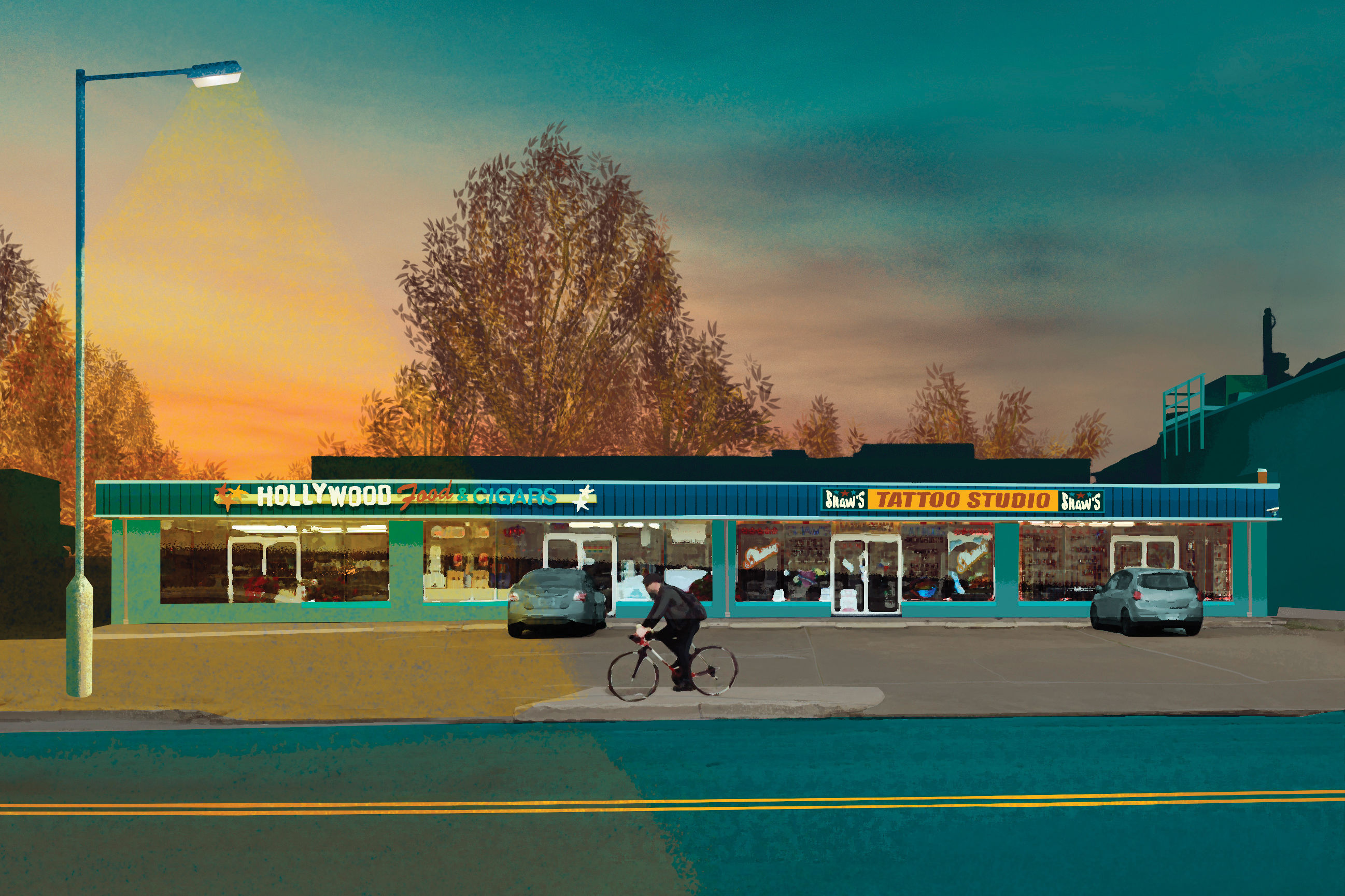
When cranky comedian Lewis Black performed at the Laff Stop, he fixated on River Oaks Shopping Center’s two Starbucks stores, facing each other across West Gray Street. With unusual calm, Black delighted in Houston’s sprawl and almost parodic strip mall layout, remarking, “I’ve seen the end of the universe, and it happens to be in the United States, and, oddly enough, it’s in Houston, Texas.” The Laff Stop spent its final years on Waugh Drive and Allen Parkway before closing in 2009.
Today, Houston’s comedy scene includes the conventional Houston Improv, the edgier Riot Comedy Club above Montrose mainstay Rudyard’s, and the punk-leaning Secret Group in the shadow of East Downtown. Outlaw Comic alumnus Andy Higgins still frequents the Monday night open mic at Riot. Comedy superstars Dave Chappelle and friend Mo Amer, who grew up in Alief and gave us the epic, Houston-proud Netflix show Mo, have been known to drop by unannounced at the latter venues to test out new material before major shows. Amer’s show Mo treads close to satire and isn’t shy about sharing our funny idiosyncrasies. He revels in our contradictions and clearly loves this community. Station Theater continues the legacy of the long-departed Comedy Workshop through improv performances and classes.
A handful of Houston visual artists also stand apart for their sense of humor. Dixie Friend Gay’s Books of a Feather sculptures at the Alice McKean Young Library depict three 15-foot-tall birds adorned with ceramic tile and bird-themed book titles. Ever since climbing onto Jim Love’s Portable Trojan Bear as a child, I’ve cherished the work of this industrial-materials master. The sculpture still stands in Hermann Park, beckoning children to climb on and engage with public art. Love’s witty and whimsical Call Ernie, fashioned from a discarded oil pump jack into a makeshift airplane, greets travelers at Hobby Airport, while his bright red Jack on the Menil campus continues to delight passersby.

Image: James Glassman
Houston-born filmmaker Wes Anderson put his wry, dry sense of humor on full display in his second feature, Rushmore, which was filmed in and around the city. In the first of his many film collaborations with Bill Murray, Anderson elevates comedy through Murray’s performance as a lovelorn Houston industrialist. It’s hard to imagine Murray’s Oscar-nominated role in Lost in Translation if Anderson hadn’t cast him as the sad clown in Rushmore. (Jason Schwartzman’s character, Max Fischer, gets the best lines, but everyone in Rushmore got to be funny.)
Houston doesn’t reserve its humor for artists and performers alone. Philanthropist and newspaper publisher Oveta Culp Hobby delivered a sly and ironic line about Houston to Life magazine in 1946: “I think I'll like Houston if they ever get it finished.” Nearly 80 years later, the joke still lands.