These Houston Photographers Honor the Dignity, Beauty of Gray Hair

Image: Courtesy Masha Glebova
Gray hair is not just gray hair. It’s identity and defiance against expectations. It’s welcoming aging as an inevitable mark of experience. And for some artists, it's a way to ask viewers to acknowledge issues like misogyny, ageism, classism, health care disparities, racism, and climate change.
“I think it’s important, if we want to avoid this pressure for women who don't want to dye their hair, because art shapes how we see the people, how we see the world,” says local photographer Masha Glebova. “And if we only show just young faces in art, in magazines, in advertisements, everywhere, we create false ideas that only young faces have value.”
In celebration of aging, Glebova and other Houston-area photographers have turned their cameras toward older, gray-haired women to honor their strength, presence, experience, and beauty. It’s a protest against a world preoccupied with feminine youth. “I decided to stop dyeing my hair around five years ago, and I was really surprised by how many people started to tell me that I should dye it again,” Glebova says. “I felt pressure and judgment.”
Her Silver Waves series currently comprises 12 portraits of women embracing their natural gray hair. Glebova sought out everyday women, not professionals in the beauty or fashion industries. Models have come from Facebook groups populated by older women, and included others from across the Houston area who heard about the project. Before the photo sessions, each model completes a questionnaire about the motivations behind their decision to not dye their hair. Information gleaned from these testimonials helps shape the final portraits in Silver Waves. Glebova plans to submit the photos to galleries for a possible show and compile them into an accompanying book with excerpts from questionnaires.

Image: Courtesy Masha Glebova
The results are stunning. Shot in a studio, the models position themselves with graceful, elegant gravitas. Some stand. Some drape themselves on lush chairs. Some opt for simple headshots. All of them are given control over the visual narratives they share with the world.
Glebova views her series as an act of solidarity. She understands the pressures women face as they begin to show their age. “During this period, when not all your hair is gray…it looks a little bit weird…. You sometimes think, ‘Maybe society is right. Maybe I should dye my hair. Maybe it will be better for me, for my appearance,’” she says. “I wanted to support other women [in] that way, and I created this project.”
Local visual artist Cressandra Thibodeaux explores similar territory. Though she and Glebova have never collaborated, both their portraiture centers older women, and their work could easily be displayed on gallery walls as if in conversation with one another. Thibodeaux’s work on the subject take two paths—a series documenting the lives of women belonging to the Sault Ste. Marie Tribe of Chippewa Indians (she herself is a member), and a series featuring one of her favorite subjects: her mother.
“I love the wrinkles. I love the look of an aged person…. Thirties and forties [are] kind of freaking boring,” Thibodeaux says. The feedback has been rewarding and affirming. During previous shows, she says, “Constantly, women would be coming up [saying], ‘Thank you. Thank you for making us visible.’”

The photographer began collaborating with her mother, Marilyn, when the latter was hospitalized three times with COVID-19, and a fourth time following an adverse reaction to medication. Doctors told Thibodeaux’s mother that she needed at least 10 minutes of activity per day to optimize healing, so they began working together on a portrait series. They’d develop concepts, drawing inspiration from the natural world and Marilyn’s previous work as a fabric buyer in the 1960s.
The resulting works chronicle an older woman’s struggle against a health care system in which services advertised as free still resulted in unexpected bills, and doctors and others didn’t take her complaints seriously. The series documented a fight against her own mind and loss of autonomy as dementia began to settle in. “The disrespect that elders get is so offensive from every institution, but especially the health institution,” Thibodeaux says. “My mother would always say, ‘Oh, they think I should be grateful that I’m alive.’”
While older women are underrepresented in media (the Geena Davis Institute notes that women receive only around 25 percent of movie roles intended for actors over 50, and “are more likely to be depicted as senile, feeble, and homebound compared to their male counterparts”) and health research (think of the resources available for people experiencing menopause vs. those with erectile dysfunction), this holds even more true for women of color, including Indigenous women like those in Thibodeaux’s pieces. Two of her 20 portraits of elderly women from the Sault Ste. Marie Tribe of Chippewa Indians are currently on display at the Detroit Institute of Arts’ exhibition Contemporary Anishinaabe Art: A Continuation. One captures the late Cathy Marie Abramson, former chair of the National Indian Health Board, at a family feast. She was undergoing treatment for breast cancer during that period of her life.
“It was hunting season, and they had gotten a deer, and her family had come together. So, I got to photograph this whole generation of people,” Thibodeaux says. “Her husband was like, ‘She is dying. She has a few months to live. Please, just take the photo.’” The portrait also serves as an unapologetically straightforward statement on the risk the entire nation endures, and how Indigenous women are often subjected to not just invisibility but the effects of ecological devastation and environmental racism. The nation is located near a Superfund site, a designated contaminated area, and nearby residents are known to experience higher cancer rates, birth defects, and illnesses.
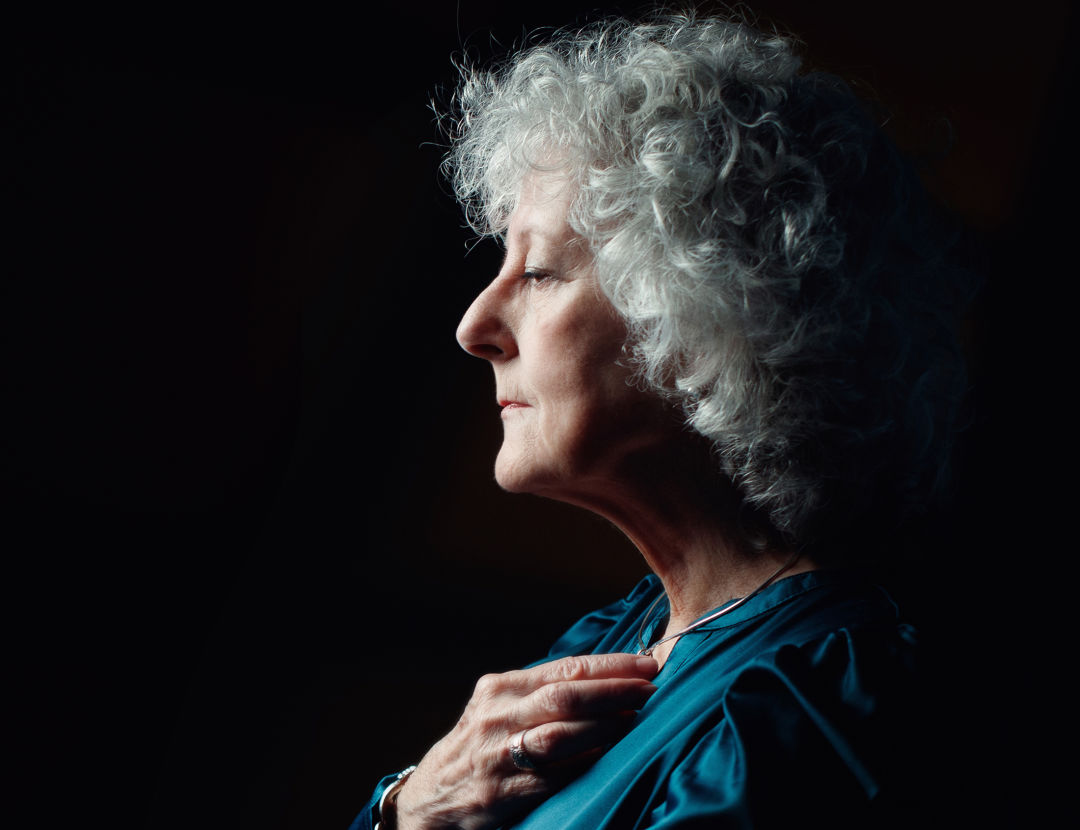
Image: Courtesy Masha Glebova
For the subjects in both artists' work, greater visibility can help people feel comfortable in their bodies and command respect from viewers. Glebova's and Thibodeaux's choices promote a much healthier perspective than the one usually circulated to the public. “Aging is a natural process,” Glebova says. “It’s beautiful. It’s full of depth.”