The World Cup Is Giving Cape Verdeans Everywhere a Moment to Feel Seen

Image: Sipa USA via AP
Growing up as a Cape Verdean American, I’ve always had to explain my culture to others.
I spent years shouting Cape Verdean culture from the rooftops (social media!)—searching for celebrities with Cape Verdean ancestry as evidence of existence, pressing the history on anyone who would listen—only to be met with blank stares or the occasional person who had actually met a Cape Verdean before.
Outside of New England, where my family and most Cape Verdean immigrants settled en masse in the late nineteenth century, finding kriolos elsewhere in the country has felt rare. I’ve met a handful in Washington, D.C., and California, and exactly one in Texas—each encounter feeling like kismet, as if our ancestry was drawing us together like magnets. But eventually, I stopped talking about it with strangers. I no longer needed the validation or to explain to the world who I was, I thought. I knew who I was.
Then came the World Cup.
With the Republic of Cabo Verde playing in the international tournament for the first time, and goalkeeper Josimar “Vozinha” Dias stunning the world with his performance against Spain, I’ve seen more coverage of Cabo Verde in a single week than in my entire lifetime. Tickets for Houston’s match between Cabo Verde and Saudi Arabia jumped from $200 to well over $700 overnight, and Vozinha has become an instant Instagram sensation, with more than 13 million followers.
For a people long accustomed to being seen as obscure, it has been something to behold. Turns out, being seen feels pretty good.
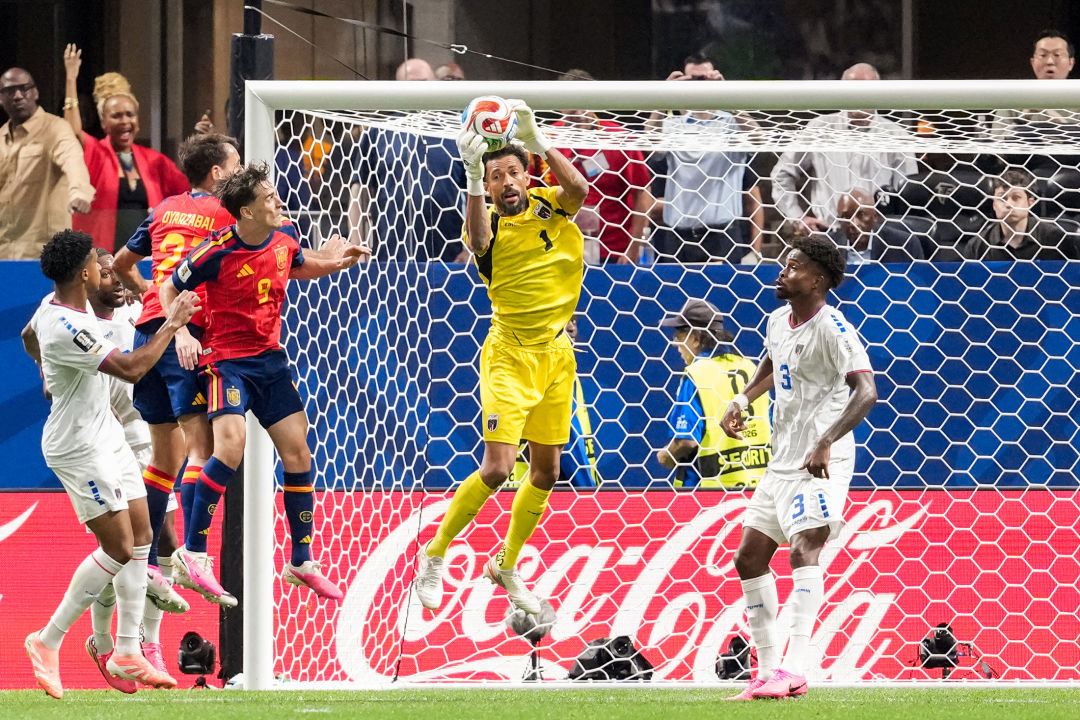
Image: Sipa USA via AP
“Social invisibility” is common for Cape Verdean Americans, writes Marilyn Halter in her book Between Race and Ethnicity: Cape Verdean Immigrants, 1860–1965. Our history has been largely eclipsed—by Portuguese history on one side, and by African studies on the other—particularly in America, where racial ambiguity can breed discomfort and identity is usually reduced to Black and white. In Cabo Verde, it’s never been that simple.
The Portuguese colonized the islands in 1462—turning what had been uninhabited land into one of the first slave markets in West Africa and, later, an important stopover on the transatlantic slave route. The islands became home to descendants of an incalculable combination of African and European ancestry—people of all shades who spoke Portuguese and Crioulo, the enduring mother tongue that blends African languages and earlier forms of Portuguese.
Life on the islands was hard. The archipelago’s volcanic terrain was ill-suited to agriculture, and many residents left starting in the mid-to-late 1800s in search of survival, resulting in what historians describe as the first voluntary transatlantic voyage from an African nation. Most took boats and whalers west to the US, landing in my birthplace, Providence, Rhode Island, and in New Bedford, Massachusetts, which still has one of the largest Cape Verdean populations in the country.
Integration in the US was no easier. Immigrating often required Cape Verdeans to define themselves as African or Portuguese—never both—and to read and speak English. The full spectrum of skin colors and hair textures that Cape Verdeans carry confounded American racial categories (Claire Andrade-Watkins’s documentary Some Kind of Funny: Porto Rican? A Cape Verdean American Story captures this history with particular care). The Portuguese often denied and distanced themselves from Cape Verdeans. Other Americans labeled them—subjecting the darker-skinned and “non-passing” to the same racism as other Black Americans, similarly disregarding their vibrant, complex, and storied ancestry. As with the broader African American experience, many continued to live as Black Americans did. Others chose proximity to whiteness by solely claiming their Portuguese heritage. In many cases, Cape Verdean heritage would take a back seat publicly unless there was a true community to support it.

Image: Sipa USA via AP
Even now, when I mention Cabo Verde in the States, I’m usually met with a headshake. The US State Department notes that the Cape Verdean diaspora in America rivals the islands’ current population of roughly 490,000, and yet most Americans couldn’t place Cabo Verde on a map. Most of us were never taught the history or the country’s significance, and that could be considered by design.
When a people are told for generations that they must choose between identities, when their history is absorbed into larger national narratives on either side of the Atlantic, when their very appearance defies the categories a country insists upon—invisibility can become the inheritance.
I am still learning about Cabo Verde myself. The great-granddaughter of immigrants on my father’s side, I never learned the language. I’ve never traveled back to our “home country,” and yet the sodade—the deep, melancholic longing for it that Cape Verdean icon Cesária Évora once sang about—is real.
This past month, I’ve felt a pride I struggle to name. I’ve gone back to photos, to research, to memory. I’ve swiped through endless videos of Cape Verdean crowds proudly waving their flags. I’ve felt seen, and even though I’m not the biggest soccer fan, I’ve felt included. I can only imagine what this moment means for the fans of every other first-time nation on that field.
It’s amazing how seeing yourself can reignite pride in who you are. The World Cup is, truly, a world stage. I’m glad Cabo Verde is finally getting its shine.