Meet the Houston Artists Turning Trash into Something Worth Keeping

Image: Courtesy of Texas Art Asylum
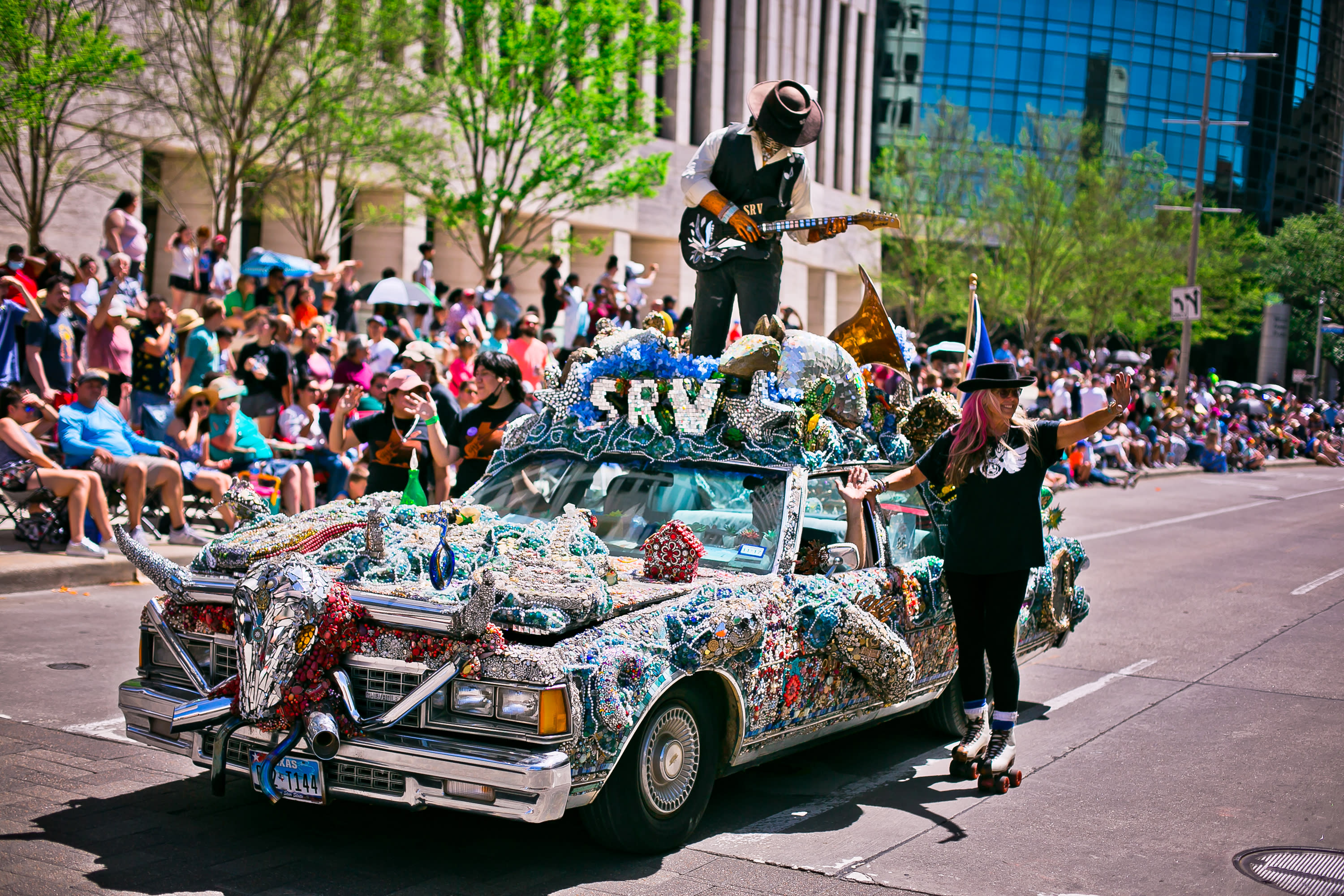
This year’s Art Car Parade, presented by the Orange Show for Visionary Art, was a pretty trashy affair. And that’s a good thing.
Houston’s illegal dumping problem generated over 8,000 complaints in 2024 and 2025, costing the city $18 million as part of a civil rights settlement for the Houston Gardens and Trinity Gardens neighborhoods. Creative projects that keep garbage out of landfills are one way to combat the problem. Not a panacea, of course—illegal dumping and other ecological harms are serious public health issues, and touting only one solution as definitive would be irresponsible.
“Our natural resources, including our water resources, are becoming finite. We only have so much forest left. We only have so much prairie land left,” says Jamie Ford, a regional interpretive specialist for Texas Parks and Wildlife (TPW).
Still, artists are finding ways to draw attention to this by using found materials in their works, providing a valuable service to the city.
TPW debuted its first-ever art car at the 2026 parade this past April, decorating it with reclaimed materials. “Anything that we can do to not add to the trash” is beneficial, Ford says. “But also, just getting people to recognize that whatever you have on hand can become art, or can be used for different purposes.”
For its initial foray through Downtown’s temporarily bedazzled streets, TPW decked out a Ford F-150 with hand-painted murals celebrating the activities visitors can enjoy at the 85 state parks across Texas—stargazing, camping, fishing, and wildlife viewing, specifically. Staffers and artists from around the state joined together to craft the art car, incorporating invasive plants as greenery and litter scavenged from the parks. In this design, a PVC pipe transforms into a fishing pole. Home Depot buckets become binoculars, and random bits of Galveston Beach detritus morph into a school of fish. An old, abandoned tent, well, symbolizes a tent. The hope is to inspire others “to look at their surroundings and parks in a new way,” Ford says.
She’s a veteran of the art car scene, having previously taught science at Fourth Ward’s Carnegie Vanguard High School. She also once received a grant that enabled her and her students to create and showcase their first art car in 2018. Participants in the project collected plastic water bottles from classmates throughout the school year, then used them to construct a giant wave. They threaded lights inside the sculpture and repurposed an old cooler to create a beach scene. Another year, Ford and her team covered a car in old maps. All the art cars she’s crafted with her students have made ecological statements, either outright or through their choice of materials. It’s an ethos shared by many Art Car Parade entrants, both past and present.
Burbank Elementary School students contributed Lunchables containers to create honeycombs for a bear-and-bees-themed car this year. Teachers Julon Pinkston, Alyssa Dalton, and Cynthia Terrazas, along with the students of Waltrip High School’s Art Club, repurposed old ceramics and fashioned new ones for their Art Nouveau-inspired entry. Anyone who has ever set foot in New Orleans or Galveston after Mardi Gras will certainly be relieved to see the beads incorporated into multiple car and bike designs rather than clogging the gutters.

Image: Courtesy of Gleeson Ryan
But the Art Car Parade, which just wrapped its 39th year this past April, hardly has an exclusive claim on creative reuse. It’s been a staple of Houston art history, notably in the works of Jesse Lott and the Dadaist duo The Art Guys, whose own Jack Massing currently serves as executive director of the Orange Show. Contemporary artists like Melissa Aytenfisu and Gleeson Ryan both incorporate discarded materials into their works to help keep the local ecology healthy and neighborhoods clean. Ryan, who volunteers as a docent at the Orange Show’s Beer Can House, introduces visitors to the idea that trash can be art rather than an environmental hazard. She also taught a class on the subject at the Contemporary Arts Museum Houston (CAMH).
“[In college], I really enjoyed understanding the character and the history of preexisting materials and incorporating that into the pieces that I was making,” Ryan says. “And then, when I moved to Houston about five years ago, I went to the Beer Can House and immediately just fell in love with that…I love the sound that the beer-can curtains make in the wind…I found that really inspiring.”
Because of her work with the legendary local architectural curiosity, Ryan is especially fond of reusing metals in her mixed-media practice. Lately, she’s been making chain mail and jewelry from coins, washers, safety pins, soda can tabs, and other repurposed metals, and she’s recently started experimenting with plastic. This past Earth Day, she led a project at Discovery Green to collect water bottle caps, rallying over 200 participants to create a repurposed mural.
“You’re preventing the creation of new materials in our already resource-constrained world,” she says. “You’re reducing the amount of waste that’s going through a landfill or going to be recycled, and then also you’re having the fun side of being able to play with the character and history of these materials in a way that’s interesting for art.”
Aytenfisu agrees with this philosophy. While working on Midtown’s Hue:Man Shelter public art initiative, she trained the houseless artists under her mentorship to draw inspiration from what they encountered while out walking. She passes the same lessons to her children as they take family strolls around their Third Ward home.
A painter and printmaker by trade, she first became interested in using found materials while teaching art to kids. Broken toy parts found their way into her lithography and intaglio prints. Aytenfisu later started seeking out anything with interesting patterns, shapes, or compositions, and collecting whatever caught her eye in cardboard boxes. Sometimes this involves “broken pieces from a construction site or remnants from a car accident” and “repurpose[ing] them in a more hopeful way,” she says.
In this, the stories behind the rescued objects become just as much a part of the narrative as the final art piece itself. She recounts one memorable instance of finding a pair of soles in “mint condition,” completely separated from their shoes. “The idea of using those prints—the soles of a shoe to walk across a canvas—just had so many layers of meaning, like, ‘How did those shoes get left there? Whose were they?’” Aytenfisu says.
Not everything she salvages from the scrap heap is necessarily found on the ground. As with many artists, art teachers, and other fans of secondhand goods in Houston, she also patronizes Texas Art Asylum on the East End, both as a shopper and a donor. This 6,500-square-foot, donation-based store sells and accepts almost anything imaginable that creatives can use to further their practices, though the staff keeps a running online list of items they’re not currently accepting. Aytenfisu loves browsing their extensive collection of photographs and postcards, particularly the ones with dates and writing on the back. “That speaks to my art practice of having a narrative and a story,” she says.

Since 2010, Texas Art Asylum has rescued what owner Ramona Brady estimates to be 3.8 million pounds of discarded items from landfills and currently averages about 4,000 pounds per week. Like Aytenfisu, she relishes the storytelling element that undergirds creative reuse. Many of the donations the store receives aren’t anonymous pieces of trash. They’re beloved objects and heirlooms, subjected to downsizing or posthumous housecleaning. Donating items no longer needed or wanted, rather than disposing of them, helps the environment while offering donors peace of mind.
“It’s really important for people who are donating to know that the stuff is going on to a good home,” Brady says. “There’s a lot of emotion in cleaning out your mother’s stuff…Having it have a good place to go really means a lot to people.”
Items purchased at Texas Art Asylum have found new purpose—in collages and assemblages by local multimedia artist Chasity Porter of Dormalou Project, the mosaics at Orange Show’s Smither Park, props with Houston Grand Opera, and, of course, many of the city’s art cars.
Creative reuse isn’t always simple, Brady says. It can prove a challenging pursuit in more isolated areas, as artists may not be able to access the amount of trash or recycled materials that their practices require. To address this geographic disparity, Texas Art Asylum operates an Etsy shop so non-Houstonians also have their pick of primo loot. This allows a wider range of creators the opportunity to explore the possibilities of nonstandard media and, in turn, helps keep the planet a little cleaner while also filling it with art. While this doesn’t offer an end-all, be-all response to environmental devastation, it’s still part of the solution—one that Texas Art Asylum, Aytenfisu, Ryan, Ford, and many others are more than happy to evangelize.
“I helped some friends out with a massive home purge recently, and we filled up some giant Rubbermaid tubs,” Brady says. “And I was like, ‘See, isn’t this better than throwing it out?’ And they were like, ‘Yeah, but now we’re going to go in, and we’re going to spend more money on stuff in the shop.’”