Houston’s Oldest Choir Is Still Singing

Ask anyone who has ever taken part in a choral or other collective singing performance, and they’ll describe the transcendent feeling that comes with voices rising to meld together into a forceful, immersive whole, wrapping the audience in sonic wonderment.
And then there’s the Houston Saengerbund.
Vice president Larry Harms describes the organization as “a drinking club that has a singing problem.” In fact, it bills itself as such on its own website. Though officially founded in 1883, Saengerbund's roots date back to 1847, during the era of pre–Civil War German immigration to Texas, when song, dance, and rivers of free-flowing beer served as touchstones of the communities left behind.
“The music was paramount, because there is, even to this day, a very, very strong culture of music in Germany. They have music contests. They have singing contests. They have choir contests,” says Saengerbund president Rodney Thorin. “And that is how they operated as a society back in the old country, and they brought that with them.”
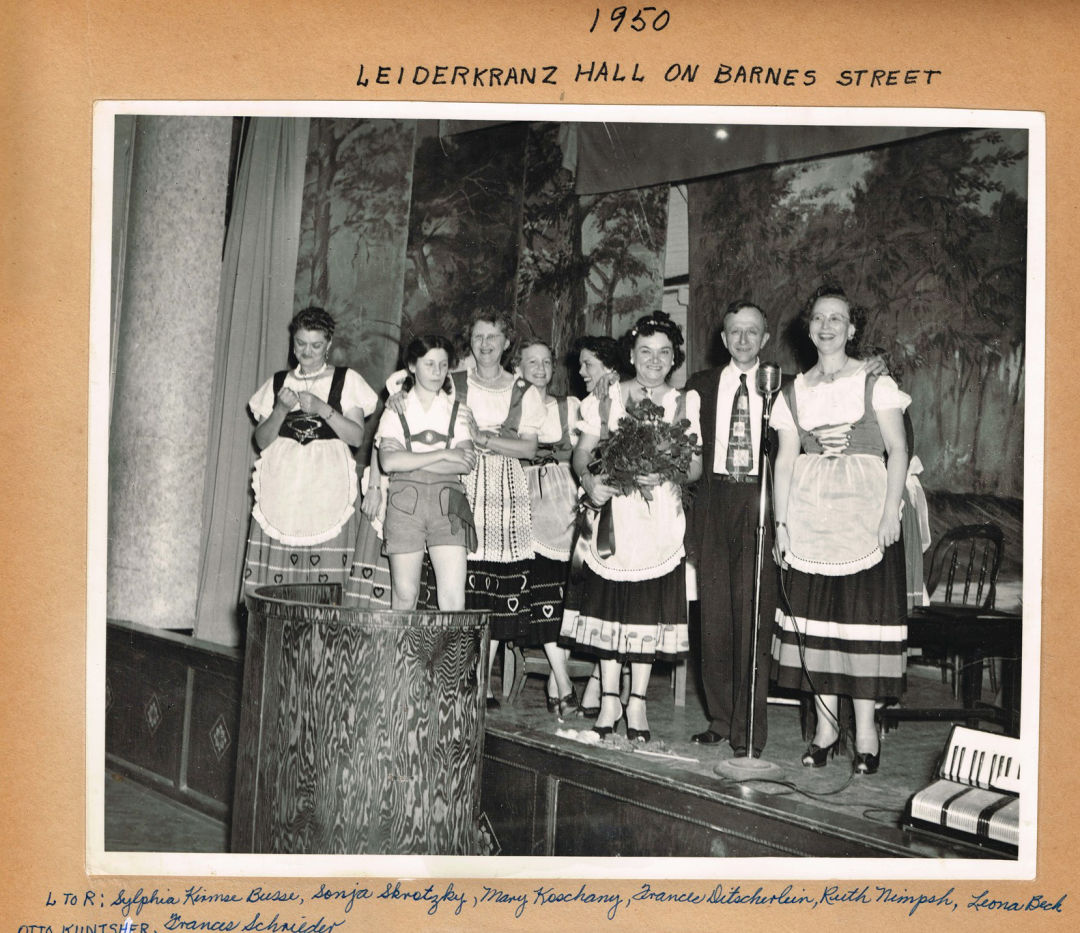
He also claims that Saengerbund is Houston’s oldest singing group, even when factoring out its origins in the local German Quartette Society, from which it is theorized to have spun off. The organization has operated continuously for almost 145 years with a single mission: to sing and drink (not necessarily in that order) as a community, just like the city’s original German immigrants once did.
In this, there’s a bridge between the Gulf Coast and the Old World European sensibilities that still give Fredericksburg and other Hill Country locales their tourism-friendly flavors, upon which German singing societies once flourished; Thorin estimates that, pre–World War I, there were anywhere between 70 and 100 such organizations in Texas. Most of Houston Saengerbund’s peers from the past century have since disbanded due to a combination of anti-immigration attitudes and the normal entropy of time.
“It's no different than organizations today,” Thorin says. “Somebody has a great idea. They want to have a society. They have a bunch of volunteers who run it. One who was carrying it gets sick, or gets tired of doing it, and it kind of falls by the wayside, and then somebody else picks up the mantle and does it a little bit differently.”

Both Thorin and Harms have been part of Houston Saengerbund leadership since 2016. They say one of their biggest challenges is finding relevant ways to bring nineteenth-century art to twenty-first-century audiences while maintaining its ties to history. Putting works by Bach, Beethoven, and Brahms on the show calendar is one method, as even those possessing little familiarity with the annals of classical music know their names, making them ideal entry points into the society’s mission. Christmas songs—notably during its annual Weihnachtskonzert (“Christmas concert”)—and traditional German operas also make their way onto the performance schedule. Not everything they sing is necessarily in German, either. For the United States’ 250th birthday this year, Saengerbund will perform a range of American folk songs. Other shows incorporate Broadway favorites into the mix, and members from Puerto Rico will contribute Spanish-language songs to the programming as well.
“Our job is to make it interesting and give people reasons to come to our events, make it entertaining, and then give our membership a reason to put forth the effort to help us with this, because it's something that they themselves love,” Thorin says. “They love the music. They love to sing. They love to play instruments, and they love the community of it all.”
In continuing German music traditions, Saengerbund also hosts singing competitions for vocal talent on the cusp of launching national careers. They perform at local Oktoberfest events and travel to other parts of Texas to compete against groups from Austin, New Braunfels, San Antonio, and Dallas. Historian and educator Moritz Tiling chronicled Houston hosting similar tournaments for choral champions in his 1913 book, History of the German Element in Texas. It’s a thread connecting centuries, beginning with the original 24 singers and 50 general, non-singing members of the original Saengerbund meeting up at the local Turnverein, a German-style gymnastics club.

Right now, there are 165 members of the Saengerbund, though only around 70 to 75 actively perform. Beyond the formal shows, the singing society meets every Tuesday to do exactly what the founders envisioned almost a century and a half ago. They meet up in their Saengerhalle (literally “singer’s hall” in German), now housed in an old Heights church, for an evening of song and beer. “You go to a community, and you sing together. We have kind of lost that in the US, but that still is a really vital part of every German community,” Harms says.
Saengerbund’s Saengerhalle has moved from home to home throughout its life. In the late 1980s, when it was located on Feagan Street near the corner of Heights Boulevard and Memorial Drive, a fire destroyed some of the society’s records, though the remnants have since been archived at University of Houston for safekeeping. The group survived Prohibition, but only barely (“If you can't serve beer, why are you going to be a member?” asks Thorin). Feagan Street remained home from 1935 until 2004, when Saengerbund was forced to sell the property owing to rising property taxes and maintenance costs. They operated from various spaces around Midtown, primarily First Evangelical Lutheran Church, until purchasing their current Saengerhalle at 1703 Heights Boulevard in 2022.

Formerly Heights Christian Church, the campus was built in 1927. Saengerhalle now occupies the church’s former fellowship hall, complete with high roofs and goose bump–inducing acoustics. Opera in the Heights also operates on the Saengerbund property, out of Lambert Hall next door. Most importantly, though, the society built a proper German Bierkeller (“beer cellar”) beneath the floorboards. They welcome anyone who wishes to stop by and celebrate the art of music (and beer) either casually or more formally. German origins do not mean German exclusivity. Especially not in Houston.
“We are not a German club. We have Germans in our club, but we’re Americans, and we live in Texas,” Thorin says. “But there's a piece of Texas history in the German influence that was here in Houston.”