The Surprising Ways Disney Built Houston

Image: Courtesy of Houston Airports
On the surface, there isn’t much ideological overlap between Disney and Houston. We have cowboys; they have princesses. Our engineering put a man on the moon as part of a proxy battle campaign during the Cold War. Their engineering redefined the concept of wonder and whimsy. But starting in the 1960s, Disney creative and engineering experts—dubbed Imagineers—began contributing to several Houston institutions, becoming a hidden yet foundational part of the city.
Ed Henderson and the Gestation of AstroWorld
If Houston had its own Walt Disney, it’d be Roy Hofheinz.
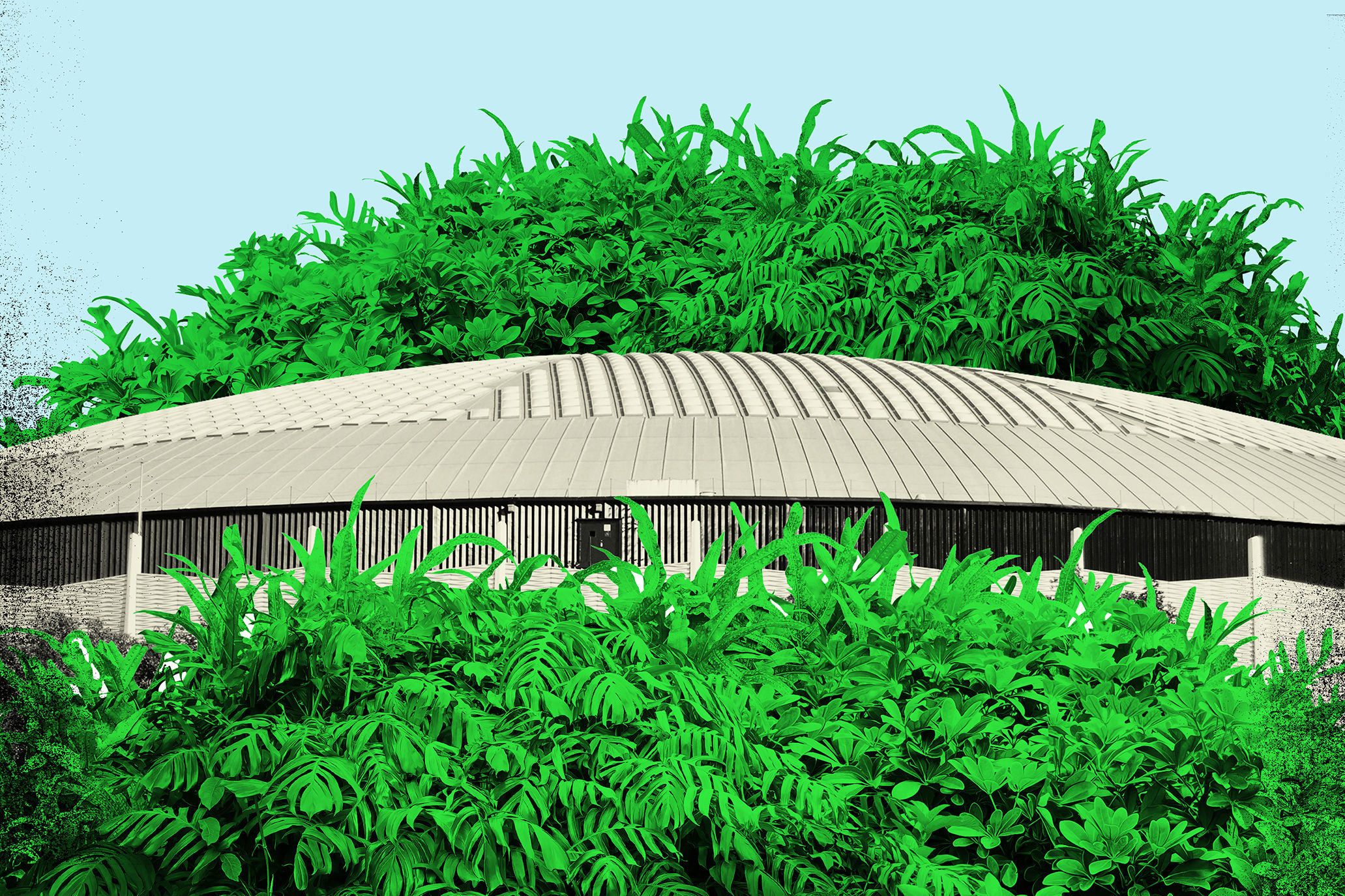
After losing a special mayoral election in 1955 following backlash over his integration of public spaces, the man known affectionately as “the Judge” turned his attention to creating an iconic sports-and-entertainment complex. He purchased land on the South Loop and built the world’s first multi-purpose domed stadium, the Astrodome, and later the first theme park in coastal Texas, AstroWorld.
None of it would have been possible without Ed Henderson. The Mississippi-born artist left Houston for California to work as an animator on Disney’s 1959 adaptation of Sleeping Beauty. When he returned to Houston, Hofheinz enlisted Henderson as an integral part of two of the city’s most beloved relics.
As an animator, Henderson spent two decades creating the famous cartoons that appeared on the massive Astrodome scoreboard—a welcome respite from the teams’ typically dismal performance. He also designed the 45-pound cavalry soldier costume for Chester Charge, the Astros’ first mascot.
When Hofheinz was courting investors for AstroWorld in 1967, he tapped Henderson to craft an intricate pair of models for the formal pitches. One was an ingenious fold-up version that fit in Hofheinz’s briefcase, but his most famous work was an 80-foot miniature version of the park that showed all the early rides in startling detail. Today, it sits on display at the Downtown branch of the Houston Public Library, a testament to the power of dreams in the city.

Image: Courtesy of Houston Airports
The City’s Only Subway
Most people are unaware that Houston has a subway. It’s free to ride, carries 3 million passengers annually, and was built by Disney Imagineers somewhat out of spite. Located in the basement of George Bush Intercontinental Airport, it carries passengers and personnel around a 2-mile track between terminals and the Marriott Hotel.
During the 1970s, Disney continued to build and expand its newly opened Walt Disney World resort in Florida, including EPCOT and its famous mass-transit systems, aptly named people movers. Imagineers regularly flew from Los Angeles to Orlando to oversee construction and installation, with Houston as their most frequent layover.
Legend has it that Imagineers, particularly those within Disney’s WEDway Transportation Company, hated stopping in Houston because a previous train system there frequently broke down, resulting in long hikes between terminals.
There were no such problems with the Disney train on a recent Thursday afternoon when Jim Szczesniak, director of aviation for the Houston Airport System, showed Houstonia around. He laughs as he remembers the legend of the frustrated Disney employees. “They have supposedly told the city that they would do it for free,” he says. “And the city was like, ‘We can’t do free stuff.’ So, they bid it out, and Disney won the bid, and they ended up ultimately installing the system.” Mickey Mouse and Donald Duck even made it to the ribbon-cutting.
And what a system it is. The same cars installed in 1981 still operate 99 percent of the time, according to Szczesniak, including an ancient wooden light board that tracks the subway’s operations. The system is so old that replacing electronic components often requires building them from scratch, since the old suppliers are long gone.
The subway itself is a marvel. Each train is three fully autonomous cars long, with individual cars roughly the size of a large SUV. The tunnels through the airport’s bowels are narrow with such tight turns that the airport system has never been able to find an affordable replacement—nor are they trying that hard. Several generations of Houstonians and travelers have come to love the hidden train, and, frankly, it’s a thrilling ride—closer to a kiddie rollercoaster than a modern monorail. One worker who joined us on the trip said she regularly saw people who took it just for fun.
Houston Airport Systems just keeps refinishing the cars and letting this piece of Disney history stand. Szczesniak says they may add historical pictures and infographics in the future, but for now, he likes surprising people. “I never get tired of telling people this is Mickey Mouse’s train,” he says, grinning.
The Mouse in Space (Center Houston)
One of Walt Disney’s most famous quotes is, “I prefer to amuse people in the hope that they will learn, than to teach them in the hope that they will have fun.” No place in Houston exemplifies that more than Space Center Houston.
By 1992, the Visitor Center in Johnson Space Center Building 2 was bursting at the seams from the influx of tourists. People from all over the world wanted to see where America’s dreams of space exploration were managed and guided. The answer was Space Center Houston, and from the very beginning, Imagineers had a hand in shaping it.
Disney referred designer Bob Rogers to help build the new tourist attraction. Rumors swirled that the entertainment company was planning a full theme park in Texas. Instead, Rogers, the man who built EPCOT’s Test Track and the theme park show The Magic of Disney Animation, set out to tell the story of the space program through a series of exhibits when the park first opened. Workers on the ground wore hard hats with the Mickey Mouse logo. Today, Space Center Houston is more than a museum; it’s a three-act tale of science and space travel.
“At one point in time, we had a pre-show that featured a shuttle launch, and during that launch, a vapor would fill the room,” says Keesha Bullock, chief operating and strategy officer at Space Center Houston. “That doesn’t currently happen here today because it’s not 100 percent scientifically accurate, but I think that very much emulates what you might see at a pre-show at a Disney theme park.” At the Space Center’s Destiny Theater, a film by Rogers’s company would play. “In our early years, you had to wait in line at a turnstile, just like a ride that you might see in a themed entertainment setting,” she adds.
Over the next 30 years, Space Center Houston forged its own identity, but that Disney influence hasn’t faded. Bullock says they keep a close eye on what the themed entertainment industry is doing.
In fact, the center’s latest director of experience design, Josh Steadman, is yet another Imagineer. Steadman started working for Shanghai Disneyland in 2011, but even before that, he was an Imagineer at heart. Obsessed with the 1991 film The Rocketeer, he, his brother Luke, and Brian Crosby (later creative director of Marvel Themed Entertainment) designed a ride based on the film for the Disney Imaginations contest, a competition for amateur designers to win positions with Disney. They made it to the finals before being dropped because their work was so professional that the judges didn’t believe it was amateur. Despite this setback, Steadman eventually worked with Disney until coming to Houston in 2025, bringing a fresh dose of Imagineering with him.
“The storytelling aspect that I learned at Walt Disney Imagineering in building a castle about princesses is easily transferable, probably even more so and better so to tell the history of flights in space and space explorers,” he says. It’s led to his own personal motto: “If you think like a 12-year-old, you will always be successful in your design philosophy. Then, the stories you tell will always work.”