Fluxus Funsters Hillerbrand+Magsamen Finally Get a Long-Overdue Survey

Houstonia’s The Must List tells you about something going on in Houston that you absolutely cannot miss.
Hillerbrand+Magsamen, the working name of husband-and-wife artistic duo Stephan Hillerbrand and Mary Magsamen, has been a major part of Houston’s visual arts scene for the past 25 years. They’ve shown at galleries big and small throughout the city, including the Museum of Fine Arts, Houston (MFAH), Houston Center for Contemporary Craft, and Houston Center for Photography (though they’ve exhibited worldwide, too). Yet it wasn’t until this year that the pair finally received their long-overdue first career survey—a loosely chronological summation of their major works and themes—thanks to their longtime collaborators at FotoFest.
On display at FotoFest’s Silver Street Studios headquarters until November 22, Hillerbrand+Magsamen: nothing is precious, everything is game reflects a playful domesticity, the relationship between objects and memory, and the magic and imagination found in the mundane. Notably, it’s also one of the few exhibitions of its kind that the long-running photography organization has presented.
FotoFest executive director Steven Evans, who co-curates the showcase alongside associate curator Madi Murphy, says the exhibit is especially timely. “It's looking at family and collaboration, and it's got a very open, warm sensibility to it,” he says. “The Houston art-going public is very familiar with them and their work, but they haven't had the chance to see it all in one place at one time.”
Hillerbrand and Magsamen met while attending graduate school at the Cranbrook Academy of Art in Bloomfield Hills, Michigan. After living in New York City for a while, they moved to Houston with their two children, only 3 months and 3 years old at the time. Inspired by the Fluxus movement, which emphasizes humor and experimentation as a protest against rigid social and artistic rules, the couple set up an in-house studio so they could parent and work at the same time. Art, then, was deeply rooted in the new life they were creating together.
“What was interesting to us was the children, our family, our new lives in Houston, and so we made a very conscious choice… We're going to use our house as a laboratory,” Hillerbrand says. Suddenly, aspects of their daily lives—their children, the dogs, the errands they had to run, the chaos of a home overflowing with plastic—“all these things become this place to experiment and make art.”
Hillerbrand and Magsamen chronicle their efforts to “make the ordinary extraordinary,” as the former summarizes it. Though their work isn’t inherently about their children, parenthood, or home life, they have used and continue to use what is in front of them as the engine of their imagination. Cameras are always set up around their house to capture ideas as soon as they bloom. Now that their children have grown up and moved on to college (one studies art, the other engineering), they’ve refocused their sculptures, photography, videos, and mixed-media pieces on their current reality as empty nesters, which they expect will metamorphose as the circumstances around them shift. “This [exhibition] clearly demonstrates the phases of life you can go through—starting out, meeting each other, the excitement with that, having a family, and then the children leaving the house,” Murphy says. “So, I think it's really something that's approachable to the general public and something they appreciate on a personal level.”

This preoccupation with ephemerality is most visible in their 2014 Mandala series. Nine of the 12 photographs are on display in nothing is precious, everything is game, each one depicting a nearly six-foot-wide circular sculpture constructed of toys and other household objects. Magsamen says that much of her and her husband’s work focuses on the amount of stuff they’ve accumulated over the years, especially after having kids. Some of these works are grouped by color schemes (red and pink, green and blue), others by theme (Barbies, Legos, stuffed animals). It’s a meditation on the interplay between consumption and nostalgia, using a traditionally Buddhist art form characterized by impermanence, often rendered in sand. These, of course, are made from plastic, paint, and other man-made materials instead. “We were taking all of these objects and arranging them in these mandalas in our home as a way to find peace for them,” Magsamen says.
The duo points out some of the objects captured in the photos that are still hanging around their house, each with its own story—like a decoration from a pet fish’s tank and a single tiny Converse sneaker. Conversely, the wood floor that serves as the background of some images has since been replaced. Both the kept and the “released,” as Magsamen calls the items, peer into the complex relationship between accretion and memory. “As visitors have been coming through the exhibition, they've started pointing out objects that have connections to their lives growing up—toys that they had as children,” Murphy says. “So, I think that's kind of a nice universal connection to make as you're walking through the exhibition. It has a sense of comfort to it.”
Comfort is another major theme and the title of a 2013 photo series. Magsamen recounts how she came home one day to find Hillerbrand had crafted a 12-inch-thick wall in their garage door, constructed of random stuff from around their house and stacked like a life-size Tetris game: a gas can, an Avengers lunch box, a television set, an inflatable horse costume. Magsamen responded with a creation of her own, stuffing rolled-up blankets, sweaters, sleeping bags—even dog beds—into their front door. For Comfort, photographs of both site-specific and obviously temporary sculptures were printed on Walmart blankets rather than traditional paper. “These things that we've been talking about accumulating, we can find comfort in them, because we've made them into a blanket,” she says.

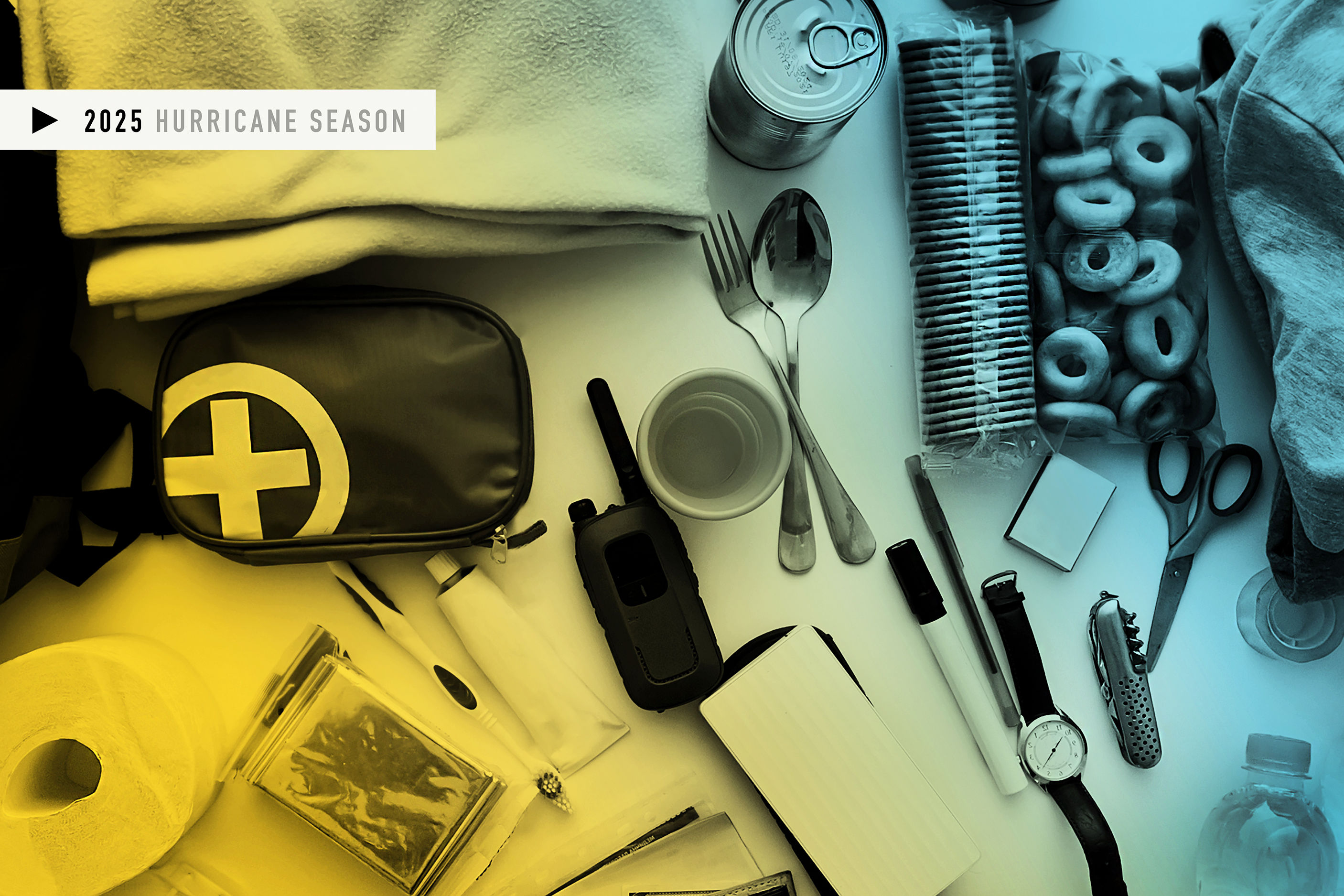
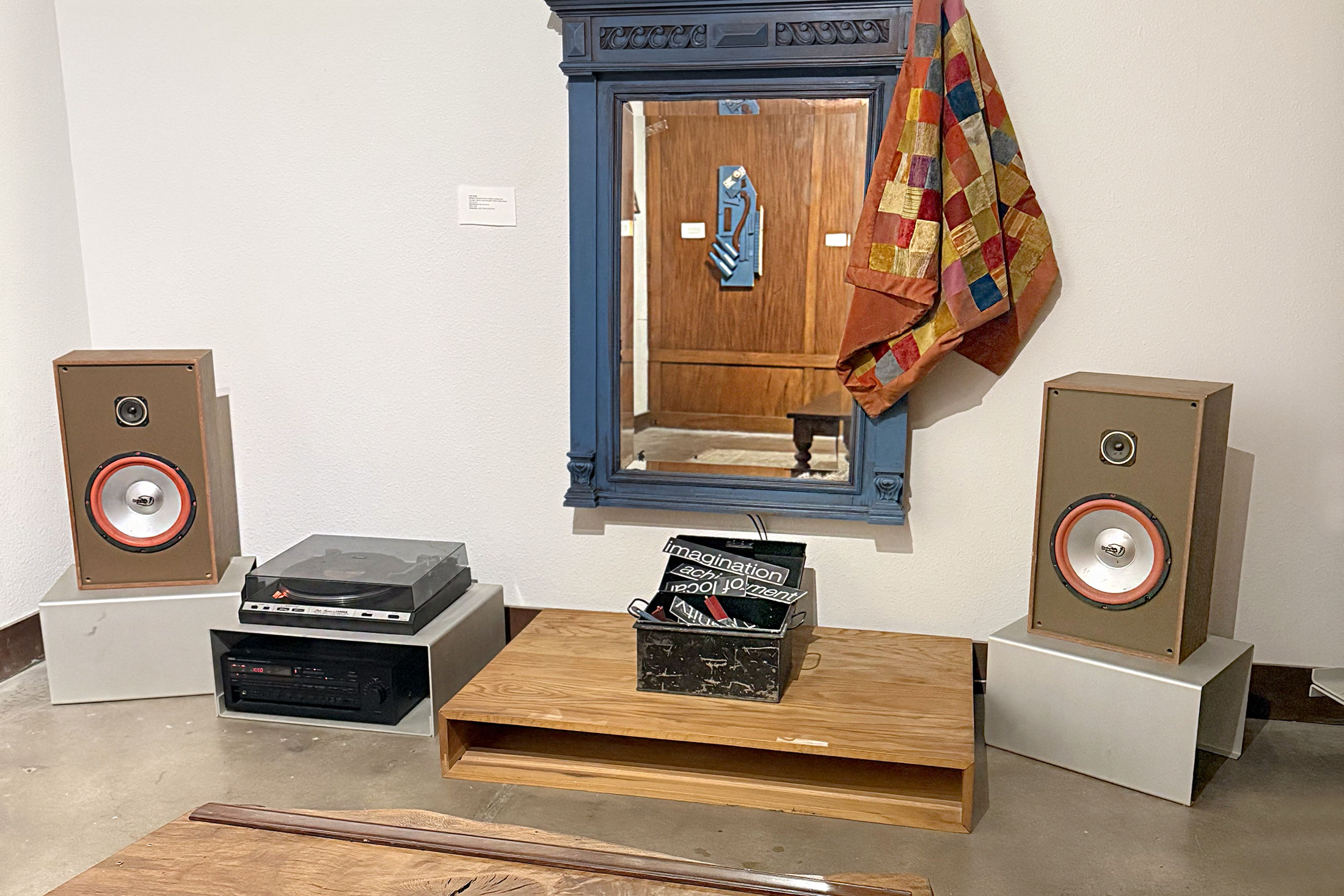
Continuing this theme is one of Hillerbrand+Magsamen’s most well-known works: the salon-style mélange of photography, sculpture, found objects, music, performance, video, and mixed media known as 147 Devices for Integrated Principles. Made in collaboration with Austin-based playwright Kirk Lynn from 2017 to 2020, the multifaceted piece, which features far more than 147 devices, came about while the family prepared their first-ever hurricane kit in anticipation of Harvey’s landfall. Here, their photos become more sculptural, sometimes involving puncturing and sewing directly into the paper. And their sculptures pushed them toward new and fun ways to experiment, like bedazzling a classic Little Tikes Cozy Coupe ride-on car and displaying it on a rotating stage as if it were a luxury vehicle. “This show has made my brain melt because it's been so fun to think about all the things. The play is not just happening thematically in the work,” Hillerbrand says. “I think the play is happening in the studio.”
Know Before You Go
- When: October 8–November 22
- Where: Silver Street Studios, 2000 Edwards St
- Cost: Free
- More info: FotoFest’s official website