The Hidden Figure Behind NASA’s Spacesuits
Astronauts, like onions, have layers. Since they can’t exactly excuse themselves mid-launch, they wear diapers. This gets covered by a pair of long johns, outfitted with tubes that circulate water throughout the suit to prevent overheating. Above that, a bladder-like piece—held in place by a flexible netted bodysuit—inflates and deflates in response to varying pressure requirements.
After all this has been secured, inspected, and approved, they can finally don the iconic orange outer layer—so colored to make them easier to spot in an emergency. Boots, gloves, and helmet snap on with literal airtight efficiency; an improper seal prevents the suit from functioning properly. Even a layman’s assessment reveals a marvel of science, engineering, and artistry. Sharon Caples McDougle deserves credit for that.
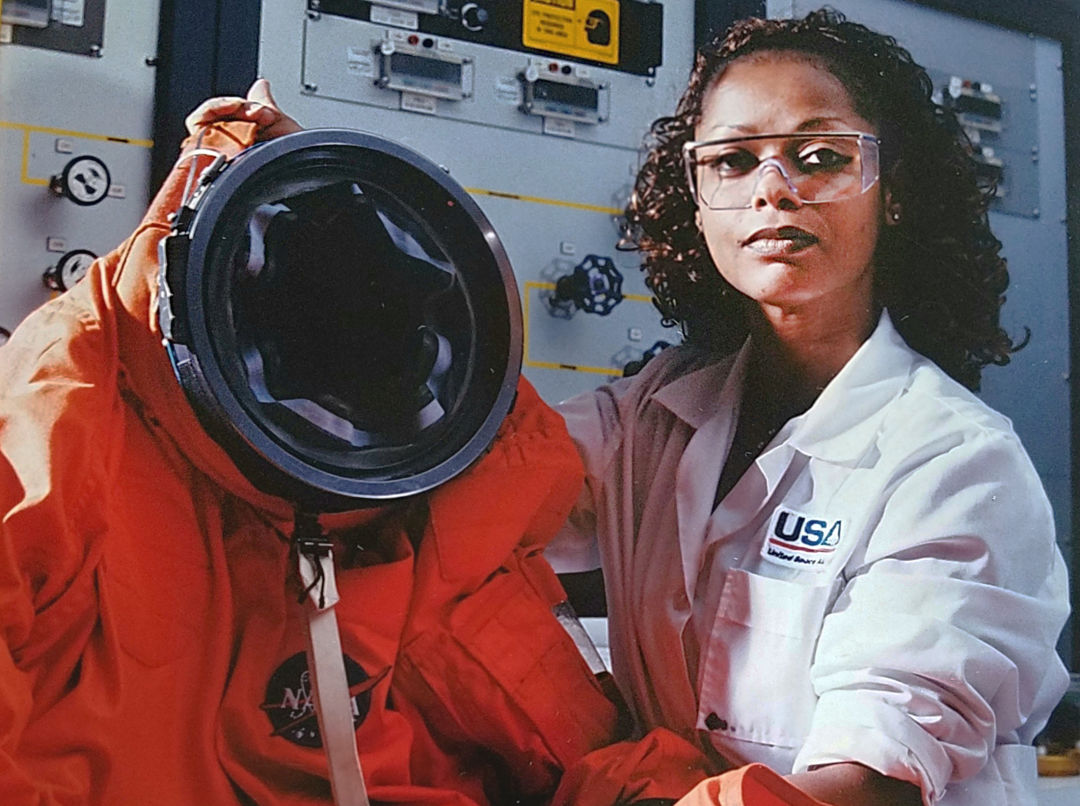
The first—and so far, only—Black and female manager of NASA’s Crew Escape Equipment (CEE) department spent her career suiting up astronauts for America’s most important missions, ensuring that these bulky, yet functional, uniforms are safe for space walks.

It’s an effort that begins a year before each launch. Astronauts get measured everywhere, down to their socks and underwear. They’re asked about personal preferences, like where they like to store their pencils, pens, or notebooks—and other seemingly mundane nuggets of information that actually prove pretty important once experts like McDougle train them to suit up properly. All changes, no matter how minor, must be recorded to account for variables once the mission begins. Not a single stitch goes unnoticed. “We were like their personal valets,” she says. “Any- and everything they needed.” But she didn’t initially launch her career intending to design one of the space program’s most critical pieces of equipment.
Growing up in Moss Point, Mississippi, as the ninth of 12 children, McDougle experienced loss at a young age. Her father died when she was just 4; her mother, four years later. She moved in with her older sister, who was already married with kids. McDougle quickly learned basic life skills like cooking, cleaning, and childcare to help around the house. “I grew up like literally overnight,” she says. McDougle credits her sister’s family with molding her into “the strong woman” she is today, as well as teachers who “noticed the change in her,” and provided encouragement, support, and a sympathetic ear.

Depression set in further when her brother-in-law was murdered after attempting to break up a fight. Even though she loved school, she felt overwhelmed by homework, housework, and pressures to go to college without the funds to support herself. Then, a sergeant from the Air Force recruiting office visited her high school. “He gave us this great speech, and I raised my hand in the auditorium that day,” McDougle says.
She enlisted on her 18th birthday and began training at Beale Air Force Base in California, starting with hyperbaric and hypobaric chambers and maintaining the pressure suits worn by SR71 Blackbird reconnaissance plane pilots. Something clicked. “I was supposed to be an aerospace physiology specialist,” she says.
McDougle left after a little over seven years due to her own concerns about safety protocols in her unit and worked three part-time jobs to make ends meet while living in Sacramento. She even considered re-enlisting before a former Air Force colleague, Regulo “Ray” Villabos, offered her an exciting opportunity at Boeing Aerospace to design and supply pressure suits to NASA.
Following a move to Texas, McDougle became, in her own words, “a modern-day hidden figure,” a nod to Katherine Goble Johnson, Mary Jackson, and Dorothy Vaughan—the three Black women mathematicians whose contributions to NASA remained largely invisible until the 2016 book and film Hidden Figures brought their stories to the public consciousness.

McDougle, too, was a trailblazer in her own right. Even without a college degree, she became the first Black spacesuit technician, the first Black crew chief, and the first female crew chief in the CEE department—a career that spanned 22 years. “I achieved it all [with]...that little Air Force training and my own integrity and character and hard work,” she says.
For the first 14 years of her career, McDougle applied the flight suit best practices she learned in the Air Force. In 1992, she served as the personal suit technician for Dr. Mae Jemison, the first Black woman to enter space. Later, she trained and oversaw 25 rotating technicians on up to three missions at a time—all the while maintaining meticulous records to ensure everyone’s safety. All told, she estimates she had a hand in about 20 total missions.

Retirement hasn’t slowed her down. Her work continues as an author and speaker who educates people of all ages on how flight suits work and the behind-the-scenes labor of spaceflight. Her charming children’s books, Suit Up for Launch with Shay! and Suit Up to Dive with Shay!, are inspired by her career and that of her husband of 34 years, Maronald McDougle, who works as a scuba diver at NASA. Illustrated by Cristielle Pimenta, both books follow the eponymous little girl as she learns about her parents’ work with the space program.
Kids are especially delighted when she brings a flight suit to speaking engagements and demonstrates how it inflates and deflates. It’s an opportunity to show children that they don’t have to become astronauts to play an essential role in spacefaring. It also promotes McDougle’s mission to celebrate all the efforts involved in space exploration, ensuring that work like hers no longer remains hidden. After all, she points out that a space suit is in no way a costume. “It’s life-sustaining equipment,” McDougle says.