
How Art Is Changing Life Inside a Harris County Jail
Bright grow lights and lush green foliage burst from stacked indoor planters. The sun streams in from large, uncovered windows, bathing bookshelves and a series of wooden tables and chairs in a cozy midday glow. The space, filled with handmade art and reading materials spanning genres, is lovingly maintained and well-organized. This is a library, after all. It also happens to be attached to a jail.
Clad in matching orange jumpsuits, Tylinn, Shayla, and Dakota* sit in a row of hard plastic chairs. They’re here to discuss the art classes they’ve taken at the Harris County Women’s Empowerment Center (WEC), courtesy of the Houston Museum of African American Culture (HMAAC) and the nonprofit California Lawyers for the Arts (CLA). To the trio, in-depth instruction in painting, drawing, collage, and other visual arts offers something rare for a carceral setting: agency, dignity, and a sense of purpose within a system that is often more focused on punishment and humiliation than on restoration and rehabilitation.
The Women’s Empowerment Center launched in 2023 as a minimum-security jail designed to reduce recidivism by addressing the root causes of incarceration—lack of education, job training, mental health support, and economic opportunity. It houses 200 individuals awaiting trial, with a mission to help residents reenter the workforce and reduce their risk of returning to jail after release—an approach that emphasizes prevention and stability over punishment.

Incarcerated people here have access to GED courses, mental health services, yoga, and career guidance thanks to partnerships with cultural institutions, educators, and arts organizations. Along with the art programming through HMAAC, residents can learn other valuable skills, including gardening, cosmetology, writing, and computer basics. Houston City College (formerly Houston Community College) also allows residents to enroll in classes while awaiting their court dates; once released, participants can complete an associate’s degree at no cost. The results are tangible, with reports of improved mental health, clearer post-release goals, and a renewed sense of self—all outcomes that stand in stark contrast to traditional punitive criminal justice models.
Dakota, now 28, has been repeatedly incarcerated since age 19 and says that the empowerment center feels fundamentally different from other jails. Exposure to vocational training in the arts and business has reshaped Dakota’s vision for life after release, including plans to open a fashion and home décor boutique.
“With me being in and out, I didn’t even really realize that I didn’t have a purpose. It was just a cycle back and forth, back and forth.… But here, with the art class and the library, even some of the staff, they really care,” Dakota says. “Even the visitors who come, a lot of them take the time to know you and know your story…so they try to help you the best way that they can.”
Tylinn proudly shows off a sketchbook filled with strong renderings of popular anime and manga characters, like Buggy the Clown from One Piece and Saitama from One Punch Man. A career in the arts may be what’s needed to move forward in life. Asserting that “it’s my first time in jail, and I don’t plan on coming back at all,” Tylinn aims to apply for HMAAC’s paid internship program, which offers job training, housing, and transportation support. Tylinn says the main benefits of the program have been the instilled “hope and the boost of confidence in yourself to actually really believe that you can go out and put these tools to work and use them.”

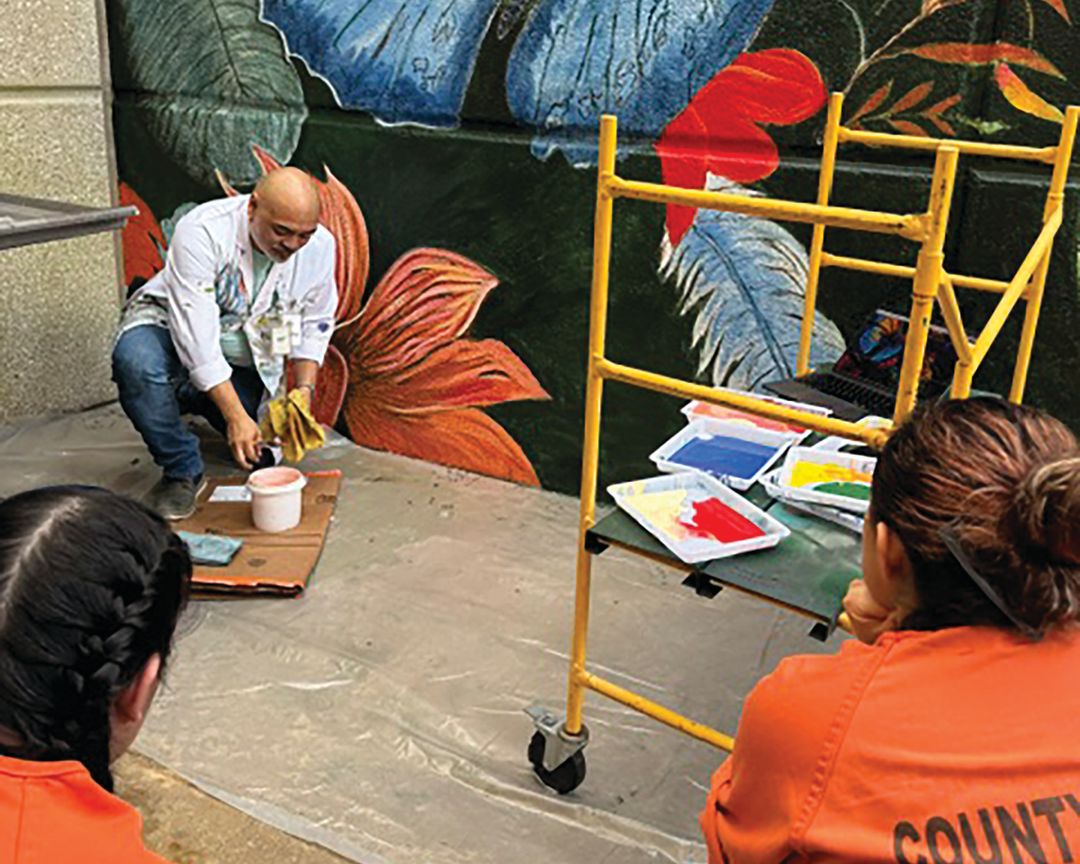
Formerly known as the Arts in Corrections Program, HMAAC’s Women’s Empowerment Arts Program (WEAP) launched roughly three years ago with goals aligned with those of Women’s Empowerment Center. In February 2023, Danielle Finnerman, a project manager at the museum, teamed up with artist Zsavon Butler to craft a mural in the visitation room, with the help of incarcerated residents. The result is a vibrant, welcoming painting on the wall, with the words “We find hope in each other. Together, the plans we make today are the way to a better tomorrow.” The work faced initial skepticism from some officers at the center, who questioned why the artists would take so much care and time on a project the officers assumed would be defaced.
Two and a half years later, the mural remains, as intact as on the day of completion. It’s become a common stop on facility tours, serving as a reminder of the center’s mission. The residents hold dear the vibrant piece set among the institutional monochrome of a jail. It’s treated accordingly as something worth preserving.
“We specialize in message murals, not just, ‘Oh, that’s great art,’ but art that says something very specifically to you,” says John Guess Jr., who was CEO of HMAAC during the program’s implementation. The mural allows visitors “to connect to the rehabilitation that the incarcerated person is having,” he adds.
Sgt. Melissa Barajas, who works at the Women’s Empowerment Center, notes that roughly 97 percent of its residents, including Dakota, are parents. The mural’s welcoming scenes of figures holding umbrellas, surrounded by bursts of color and affirming messages, help children feel at ease during visits.
Art at the center is not just decorative; it’s a major reason behind how and why the facility functions in the first place. Elsewhere, walls are adorned with art handmade by WEAP students—typed-up wishes, hopes, and dreams in both English and Spanish, arranged in gentle, comforting waves of poetry, fond recollections of loved ones, and visual reminders of the world outside.
The classes where these pieces get created are among the facility’s most popular educational offerings for first-time and repeat offenders, often filling to capacity. “I like the art class because it…teaches you how to use the tools,” Shayla says. “It helps you with your anxiety…. I just really liked it.”
It’s also a space where residents can express their emotions in a healthy, controlled manner, a rarity in an alienating, frustrating environment. Finnerman says she’s seen firsthand how the programs have helped her students at the center. She recalls a young woman with “a really hard story” crying in the middle of class, because the space felt safe enough to share “something that was so personal and vulnerable.” While Finnerman’s students receive mental health services, opening up to a counselor can be intimidating, especially if information disclosed in sessions may influence their case or sentencing. Learning about art and the foundations of self-expression in a private setting offers a path without fear that vulnerability will be weaponized in a court of law. In that way, the act of creation provides a healing release, revealing a person’s underlying humanity.
Artwork created as part of WEAP has also been published in a 2023 limited-run anthology and presented at HMAAC. Curated by Finnerman, the 2025 exhibition Beyond the Walls featured works by more than 400 artists spanning various media, including painting, collage, clay, acrylic, charcoal, etchings, and watercolor. Landscapes are a popular subject, either based on references or recalled from life experiences. One woman painted a scene from her time in Alaska. Another used photos as a starting point to paint Moses parting the Red Sea.
Indeed, many of the artists incorporate faith into their works to stay focused and hopeful. Others prefer drawing family members or self-portraits, even designing
possible future tattoos for themselves or others. Some craft collages and vision boards full of future aspirations: careers, freedom, community, travel, and luxury goods. There are so many pieces, they fill the wall from ceiling to almost the floor, surrounding visitors with reminders that people in jail are, in fact, people.
“Each one of these [artists] has a definitive story [about] why they’re painting what they painted, and that’s been really, I think, rewarding for everybody, seeing what they can do and what they’re actually capable of,” Finnerman says.
All Women’s Empowerment Center residents also receive a journal to chronicle their thoughts; even if they aren’t able to participate in art classes, the journal offers a personal, private space. “I really feel like all these programs should be done everywhere,” says Letousha, a WEAP participant contemplating a future as a graphic design or fashion professional. “Not just here in Houston, not just in Texas, but everywhere.”
The program at the jail isn’t HMAAC’s only foray into illustrating the creativity of incarcerated people, nor is WEAP its only project regarding the theme. In 2025, the museum and Houston Center for Contemporary Art also presented the exhibit Sonya Clark: We Are Each Other. The artist’s 2019–2020 penetrating textile work Finding Freedom was on display in the museum’s lower gallery, incorporating cyanotypes draped from the ceiling that depict the night sky from the perspective of escaping slaves. Visitors were given handheld UV lights to help them follow the constellations. Clark employed formerly incarcerated individuals to help, tying it to HMAAC’s primary mission with WEAP and illustrating how intersections among the arts, the criminal justice system, and economic opportunities can benefit those well beyond Harris County.
There are many overlapping reasons why people end up incarcerated—poverty, addiction, inadequate access to health services, unstable housing, lack of education or economic opportunity, and domestic violence. Tackling these issues and meeting basic needs like access to nutritious food, physical and mental health care, and a steady income can help address the root causes of criminal activity and create a path forward for formerly incarcerated people to reintegrate into society.

This concept is neither new nor novel. The Department of Justice’s extensive archive of research has long suggested that prison recidivism declines as investments in the lives of incarcerated people rise. Programs like WEAP are not breaking new ground, but rather adding momentum to a well-established argument: that a multipronged approach involving restorative justice, antipoverty initiatives, career training, and the fulfillment of basic needs is more effective for preventing reoffending than traditional policing.
Research also shows that giving a leg up to those who are incarcerated benefits the public. Barajas estimates that the recidivism rate at the center two years into the program was 2 percent, meaning only 2 percent of those who await trial at that particular jail have gone on to reoffend and cycle back into the criminal justice system. By contrast, Harris County’s overall recidivism rate between 2015 and 2024 was nearly 14 percent, according to the Texas Open Data Portal.
HMAAC has already hired one formerly incarcerated person as an intern to help with art projects and day-to-day operations at the museum; they’ve been assisting Finnerman with a 200-foot mural project, a lush rainforest vision, intended for the garden at the Women’s Empowerment Center, while also attending art classes. “I’m excited what that represents for the women that are incarcerated, to see somebody that’s been in our program that now has a job and is coming back in to work with them,” Finnerman says. “To see that, it’s uplifting for everybody, and it shows the partnerships are working.”
If HMAAC staffers and their allies continue to offer and expand their jail and prison programming, stories of people receiving career training in jail and achieving economic stability after release could become increasingly more common across the United States.
The museum is also part of an ongoing nationwide initiative launched by CLA with support from the National Endowment for the Arts and the California Arts Council. In 2011, the organizations kicked off a pilot research program to examine the benefits of arts training and the effects of recidivism in jails and prisons nationwide. HMAAC’s Guess says that he and his team have previously attempted to influence bail reform efforts to little avail, but this opportunity presents a chance to enact positive change in how criminal justice is administered in Harris County without relying on lobbying or voting.
“With evaluations and self-reported surveys of prisoners who were taking art classes, we were able to show amazing benefits that people were experiencing in classes that could be as short as eight or 10 weeks,” says Alma Robinson, executive director for CLA.
According to CLA’s initial data, students in these programs have shown increased cooperation with their peers. Some have become more comfortable sharing their emotions, feelings, and thoughts, while others have shown stronger self-expression and improved time management skills. Letousha, Tylinn, Shayla, and Dakota all endorse bringing art and career training to carceral facilities. They believe that others in their situation deserve the same opportunities to get their lives back on track after completing their sentences.
“When you come in, and you have a lot of things on your mind…it takes you to
a whole ’nother world,” says Letousha. “You feel like you’re inside what you’re
drawing.”
Robinson notes that CLA’s efforts in New York, Louisiana, and Houston, Texas, ultimately proved the most successful of the participants. She credits the successes in Harris County to Finnerman and Guess at HMAAC devoting themselves so wholeheartedly to the cause.

“The museum has such an interest in community development, and this is really something that can help not just the individuals that participate but also helps them have better relationships with their families,” Robinson says. When individuals and families benefit, communities do, too. Individuals also tend to leave with a new purpose. “When they go home, and they’ve discovered that they have talent and interests that they may not have even known about, and something to work with to build on. It gives people new hope and pride.”
Prison Policy Initiative’s 2024 data shows that Texas “locks up a higher percentage of its people than any independent democratic country on earth,” incarcerating an average of 751 people per 100,000. It’s no surprise, then, that overcrowding has become such an issue that Texas prisons and jails are transferring incarcerated people to other states, mainly Louisiana and Mississippi. Implementing proven strategies like those at the Women’s Empowerment Center can be another device to help reduce prison and jail populations.
Recidivism efforts have gained some modicum of support in Harris County. Guess says early program development meetings held with CLA in 2018 received bipartisan interest from state lawmakers. He says the county’s Democratic sheriff, Ed Gonzalez, seemed “very enthusiastic” about the idea of bringing the arts into jails and prisons when he received the proposal. Plans to open the center were already underway by then, with approved writing and cosmetology classes and an associate’s degree agreement with Houston City College. Guess remembers thinking WEAP—at the time still known as “Arts in Corrections”—would be a good fit for the jail’s raison d’être.
The program launched with a pilot writing and art course organized in part by local literature nonprofit Inprint. Combining the two disciplines proved “complicated and very challenging,” Finnerman says, but she still encourages her students to journal and take writing classes.
“Anytime that we are taking education into spaces where people cannot normally access it—because education is often a question of access and availability, unfortunately—that’s important,” says Mathew Weitman, an Inprint instructor and UH doctoral student in creative writing. “I think that’s important work to create opportunities like that.”
Inprint continues its involvement, hosting classes at Harris County men’s jails, as well as hospitals and elder care facilities. Depending on the program, classes can last between eight and 12 weeks, and writers may see their work published in an anthology. Upon completion of a course, each participant receives a certificate from Inprint. “A lot of them have never had a graduation ceremony. A lot of them don’t have that piece of paper. That really does mean something,” Weitman says. “It’s important not just for showing that they’ve done something productive with their time, but it’s also, I think, important for them emotionally.”
In fact, Letousha’s interview for this story was delayed by a graduation ceremony. Such events are not insignificant or mundane. There’s a gravitas and dignity to completing a program while in jail—be it for writing, substance abuse treatment, a GED, or something else. “For that moment, I didn’t feel like I was incarcerated,” Letousha says. “I felt like I was maybe at, you know, like a college that I can’t go home from until I finished everything.”
Given Texas’s infamy for playing fast and loose with what constitutes cruel and unusual punishment, it can be difficult to fathom how exactly Houston became one of the most notable examples of successful arts-related rehabilitation programming. After all, two-thirds of those in state prisons in Texas have been forced to go without air-conditioning during the oft-torturous summer temperatures, which have reportedly led to serious health issues and multiple heat deaths (a 2024 attempt to regulate temperatures in correctional facilities failed to pass the Texas Senate). Even in Houston, the site of such success stories, the Harris County Jail has been cited as recently as December 2025 for noncompliance in providing medical care and fire safety.
Even Guess doesn’t know exactly how things went so well—yet. “Certainly, no
one would have expected that to happen in Texas, right?” he says. But he wants to understand the specific underlying geographical, cultural, social, and economic circumstances that contributed to taking a chunk out of the local recidivism rate. He and the team at HMAAC have been working on a documentary to explore the answer, covering both the Women’s Empowerment Center and creative education efforts among the state’s incarcerated men.
While the film is in production, Guess and Finnerman continue to plan WEAP’s future. The duo is eyeing partnerships with other visual arts organizations, such as Skyline Art Services, and performing arts teachers or institutions who could offer theater training. One could certainly see the way fashion-focused students like Dakota and Letousha could thrive in costuming, or how passionate artists like Shayla and Tylinn might find fulfilling careers as set designers.
Some local arts nonprofits have also expressed interest in bringing on Finnerman’s students as interns after their release, so working out compensation and responsibilities are among the next steps for the program. “We have huge missing parts of our society that are not productive, and we have an opportunity…to make those folks productive, and that requires some work and some time and some thought of how we do that,” Guess says. He believes that giving those who made mistakes a chance at rehabilitation by equipping them with skills can not only improve individuals but also society as a whole.
Midtown Houston accomplished a similar feat with its Hue:Man Shelter public art project. This initiative partnered individuals experiencing houselessness with local artists to design, paint, and maintain murals around the neighborhood. A few participants have already secured stable housing with the pay they received for their labor. Its success is predicated on the same principles that make WEAP such a popular and effective presence in the jail: Compassion and opportunity, rather than marginalization and chastisement, are crucial to reducing homelessness and crime, not just in Harris County but across the country.
Still, donors, grant providers, and legislators seek even more quantitative data to demonstrate the programs’ actual effectiveness. The Harris County Women’s Empowerment Center’s claims of reduced recidivism so far show some promise. “This entire project was to develop the analysis that would convince people that this is worthwhile to invest in,” Robinson says. “Recidivism rates are better for people that have been involved in the arts; job prospects are better.”
Beyond the statistics, even one success story is a major cause for celebration. The humans matter so much more than the numbers in the end. Learning to draw and paint, and having the space and supplies to be creative—even simply be—allows them to see beyond the carceral cycle and into all the possibilities the outside world contains. “I do deserve a chance, you know?” Dakota says. “And there is a life out there bigger than repetitive incarcerations…. It just helps you find yourself again.”
*Editor’s note: Surnames of incarcerated people are excluded for privacy reasons.


On The Town
Houston Summer Arts Guide

New Compositions
Houston’s Contemporary Classical Music Scene Is Rewriting the Score
Space City Goes Steel City
The Houston Director Behind Alley’s Fences Knew August Wilson—And It Shows

Hou Should Hear This
How Galveston Shaped Musician Tyson Webb’s Debut Album


Only in Houston
Trump vs. Turtles, AI vs. Traffic, Meteors vs. Roofs
Art & Justice
How Art Is Changing Life Inside a Harris County Jail


Reality Reckoning
What America’s Next Top Model Taught Me—After I Made It Onto the Show

Cowboy Couture
Inside Houston’s Rodeo-Fueled Cowboy Boot Boom


Season’s Readings
Houston Bookstores’ Best Holiday Book Recommendations


On the Dance Floor
Where to Get Your Step On: Houston’s Best Dance Halls and Honky Tonks




Bring Your A-Game
This Texas City Is a Sports Lover’s Perfect Getaway


Where to Stay
Houston's Best Hotels

Get Outta Town!
The Texan’s Guide to Vacationing in Jackson Hole, Wyoming

Somewhere That’s Green
How a Houston Gardener Became One of the Internet’s Most Calming Voices

Oral History
The Houston School That Built Texas Dentistry
Best of the City
Houston’s Top Dentists 2026


Time to relax
The Hidden Texas Spa Less Than Two Hours from Houston
Somewhere That’s Green


