
The Fight to Save Houston’s Oldest Black Cemetery Started with a Sickle
When Margott Williams first arrived at her grandfather’s burial ground along White Oak Bayou, it was hidden behind a wall of unchecked vegetation.
“There was no parking lot,” Williams says. “No fence, no sign, nothing to tell what it was. The bushes were well above our heads. We were in the middle of the woods.”
“Welcome to Olivewood,” her mother said.
Williams was bewildered. All she could see was a brush forest off a washed-out dirt road. Without her mother’s certainty, she would not have recognized it as a cemetery at all. The pair was unable to move more than a few feet off the road due to the thicket.
Shocked at the state of disrepair, Williams began seeking information about the cemetery—both who was buried there, and who was responsible for its upkeep. She would learn that Olivewood is the oldest incorporated African American cemetery in Houston, established in 1875, only 10 years after Emancipation reached Texas. It is the resting place of some of the city’s most prominent founders: men like Richard Brock, a formerly enslaved man who bought the cemetery’s land and later became one of Houston’s first Black aldermen; Rev. Elias Dibble, the first Black minister ordained in Texas, who founded one of the city’s oldest Black churches; and J. Vance Lewis, born enslaved, was buried there as one of the first Black lawyers in Texas.

Within a single generation, the people interred here had gone from enslavement to building Houston’s earliest Black institutions—and using them, in part, to find their lost loved ones. “During slavery and right after Emancipation, people were looking for family members that had been torn apart—especially children,” says Williams, now the co-founder of the Descendants of Olivewood, Inc. “They’d place articles in the newspaper, use the Freedmen’s Bureau, establish communities, and look for their people. This cemetery is a statement of their right to read and write, to be a community, and to organize.”
Home to more than 400 official family plots, Olivewood’s 5.5 acres holds an estimated 5,000 people. Though largely neglected, “this was no ‘poor man’s cemetery,’” writes Antwanysha Johnson in an official Houston Archaeological and Historical Commission document. “It held some of the most beautiful statuary in the city.”
Yet, by the time Williams first visited in 2003, Olivewood’s enormous 10-foot obelisks and towering concrete angel had vanished beneath decades of abandonment and floodwater-fed overgrowth. Meanwhile, roughly two miles southeast, Houston’s first white cemetery, Founders Memorial Park, sat pristine. Funded by the Daughters of the American Revolution, it was immaculately restored for its centennial in 1936. Back at Olivewood, the burial ground of Houston’s Black founders was left to sink into the woods, unseen and unmaintained.
“I kept thinking, ‘Somebody should really take care of Olivewood,’” Williams says. Her search for Olivewood’s conservator grew more fervent, and she began visiting city officials, county offices, and the appraisal district. “They said they didn’t know anything about it.” No one seemed to be able to tell her who was responsible for the cemetery—or, more curiously, who owned it. More than 5 acres in Houston proper had been abandoned so completely that no one could say who legally possessed the land.

In 2004, the City of Houston’s legal department stated that Olivewood was “classified as private property,” and therefore not the city’s responsibility. The deeds to the land were lost to time; the only traceable ownership led back to the 21 dead incorporators buried in the cemetery itself.
Williams was still unable to visit her grandfather, and she had grown fed up with waiting. She called her oldest brother. “He had a lawnmower and a weed eater. I bought myself a swing sickle,” she says with a laugh. “I was out here sickling through plants and brush over my head. I don’t know what we thought we were doing.”
After hours of work, they barely made a dent—none of the cemetery’s landmarks were visible. The pair returned several times. Roughly a month into the project, Williams’s brother called it quits. “I’m not doing this anymore,” she remembers him telling her. The weeds would grow back, but Margott didn’t give up. She kept returning with her simple sickle, hacking away.
Her efforts didn’t go unnoticed. Charles Cook, who previously found the cemetery after his own machete-powered forays in 1993, joined Williams’s restoration efforts at Olivewood, where his great-grandmother was buried, too. In 2005, Williams and Cook co-founded the Descendants of Olivewood—a nonprofit dedicated to “restoring, preserving, and maintaining” the grounds. Community organizer Trevia Beverly and Harris County Precinct 2 Commissioner Adrian Garcia, then a city councilmember, began sending out volunteers to help restore Olivewood.
Garcia also connected Williams with residents who had grown up playing in the cemetery or had attended the nearby Harper School. “Generations of families went there,” says Williams—her mother, aunt, and uncles among them. “The kids played in the cemetery and cut through to school on a bridge that connected across the neighborhood,” she says—before I-10 was expanded.
Over time, the children who loved the cemetery became the adults who saved it. Volunteers cleared brush, hauled out debris, and slowly uncovered headstones that had been buried for decades. On one occasion, a gentleman with a brush hog—a heavy-duty rotary cutter—cleared a path for Williams and the other volunteers. “That was the first time I got to see the angel. The first time I got to see the lions. The first time I could see where my grandfather was buried,” she says.
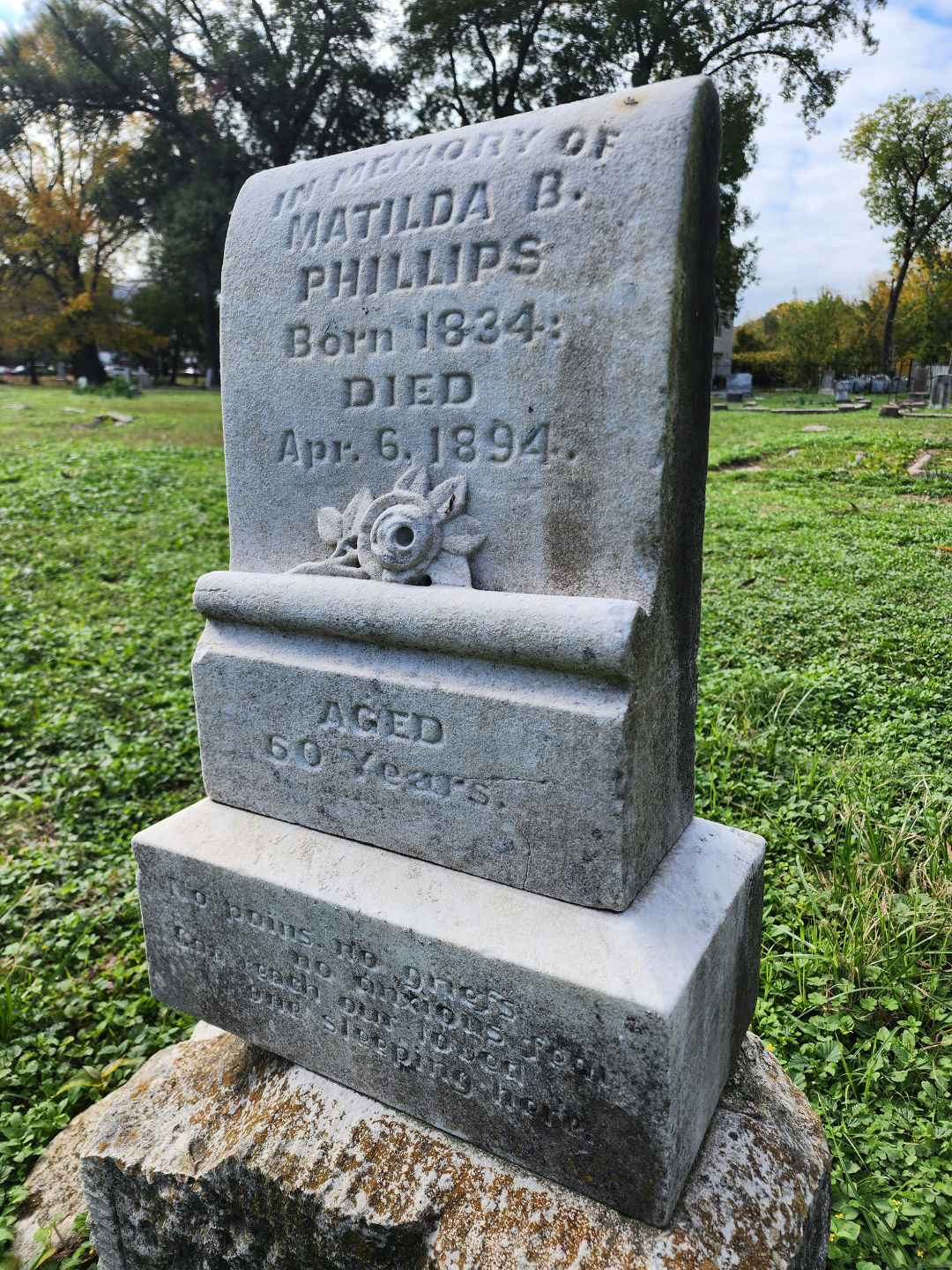
One volunteer day at a time, Olivewood began to look like a respected burial site. Monuments were visible. Families long separated were reunited, and stories were unfolding. Williams gestures to a simple headstone that belongs to a woman born into slavery. “A 12th-generation descendant emailed me, wanting to honor her. Through mapping, we located where she was, and he laid a flat stone in her memory,” Williams says. “We are literally reuniting families across generations.”
The Descendants of Olivewood became the official caretakers of the property in 2008, maintaining a cemetery still legally owned by those buried beneath it and protected by their living relatives. In 2023, it received the strongest protection in its 148-year history when the Houston City Council designated it a Protected Landmark and Protected Archaeological Site—making demolition illegal.
Few Black cemeteries in the US have ever received that kind of legal protection. Burial grounds beneath the University of Pennsylvania’s campus and a Tallahassee golf course have been paved over and sold for profit. Historian Ryan K. Smith writes that a Black burial ground in Richmond, Virginia, was “actively destroyed.” And in Bethesda, Maryland, advocates say construction crews are still uncovering human remains at a self-storage site built on what was once the Moses African Cemetery.
No one knows exactly how many sites have been lost. No federal or state agency has ever conducted a comprehensive count. However, in 2022, Congress passed the African American Burial Grounds Preservation Act, which funded efforts to locate and document surviving sites.
Still, no statute can suppress the laws of nature. Following extensive damage and flooding from Hurricane Harvey, the National Trust for Historic Preservation named Olivewood one of the 11 most endangered places in the US in 2022. Olivewood shared the list with sites like Camp Naco, an Arizona outpost tied to the all-Black Buffalo Soldier regiments, and Selma’s Brown Chapel AME Church, a Civil Rights Movement landmark—a reminder that the places holding Black history are disproportionately endangered.
These days, natural disasters are more common. “We’re having I-10 overflow events—water floods [that are] 10, 20 feet high,” she says. When Hurricane Beryl hit in 2024, it toppled trees and brush, filling areas that volunteers had already cleared. “One of our board members came out and said you could canoe from Olivewood over to Studewood Park [after the storm],” Williams says. The cemetery had become a swamp, with water and debris so deep they could swallow headstones. The image was reminiscent of her first visit to Olivewood: “You couldn’t see through any of it,” Williams recalls.

As storms bring the brush back and the floodwaters continue to rise, the future of Olivewood is both hopeful and uncertain. Twenty years ago, Williams began with a single sickle, but the work looks much different now. It involves talking to donors, securing funding, and networking. “We rely on these things because the technology and laws have changed so much,” she says.
One thing remains constant: a people who built institutions out of what little they had left their names and history in this ground. The least the living can do is keep them visible. “The dead depend on the Descendants of Olivewood,” Williams says. “It’s up to us.”

Vinyl Destination
Houston’s DJs Are Turning Their Record Collections Into a Vinyl Revival
All eyes on houston
Houston Just Had Its Biggest Night Yet at the James Beard Awards


World Cup Fever
Where to Watch World Cup Matches in Houston


On The Town
Houston Summer Arts Guide


Vinyl Destination
Houston’s DJs Are Turning Their Record Collections Into a Vinyl Revival

Hou Should Hear This
Kam Franklin’s Solo Debut Sounds Exactly Like Houston

The City Syllabus
The Houston Summer Reading List, 2026


Yes Ma’am, No Ma’am
The Best—and Worst—Things About Houston’s Hot Summers




Kickin’ It Like Chabala
I Trained with a Former Houston Dynamo Soccer Player (and Couldn’t Keep Up)
Vinyl Destination
Houston’s DJs Are Turning Their Record Collections Into a Vinyl Revival

Reality Reckoning
What America’s Next Top Model Taught Me—After I Made It Onto the Show

Cowboy Couture
Inside Houston’s Rodeo-Fueled Cowboy Boot Boom


Season’s Readings
Houston Bookstores’ Best Holiday Book Recommendations

Vinyl Destination
Houston’s DJs Are Turning Their Record Collections Into a Vinyl Revival
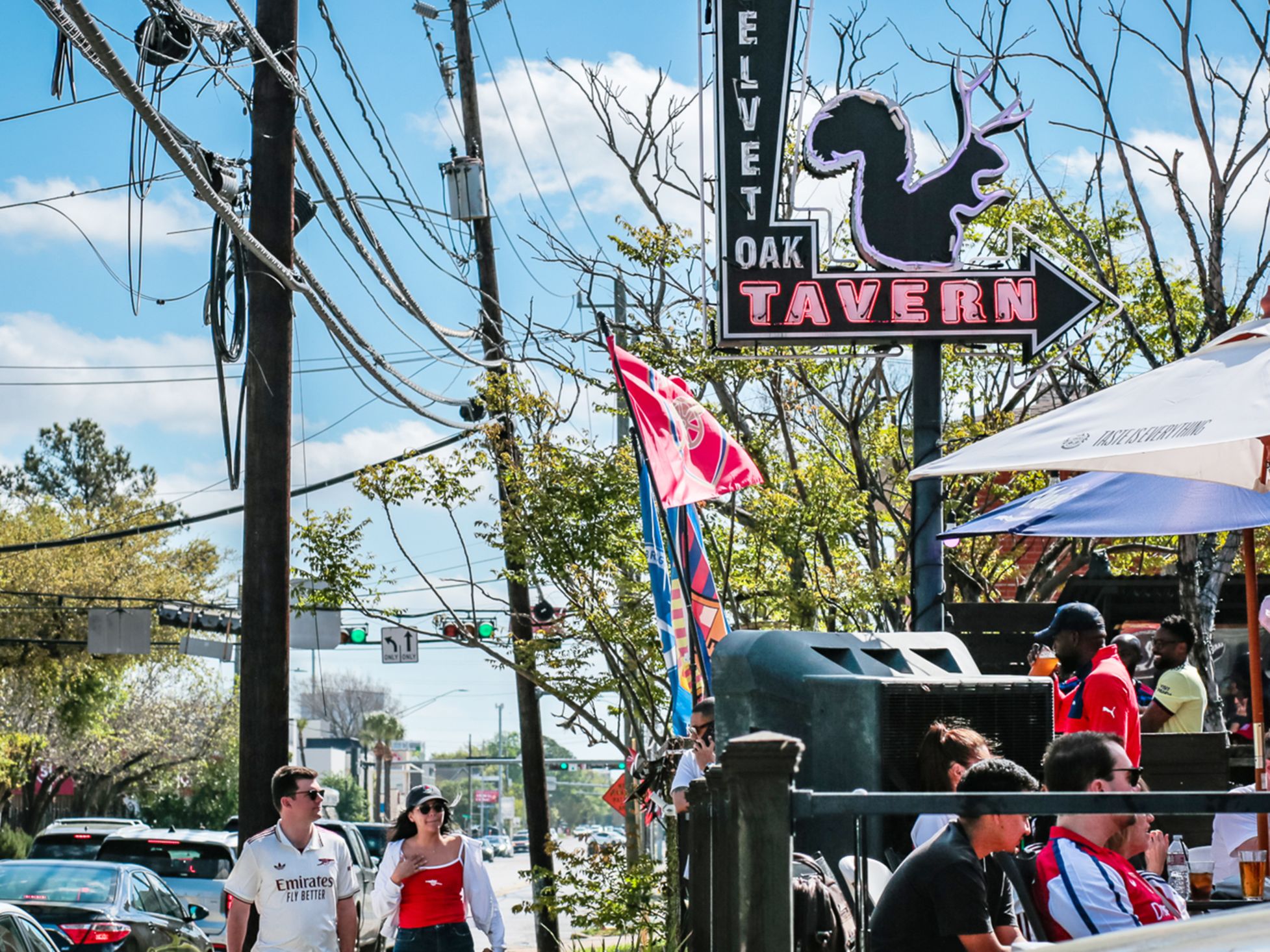
World Cup Fever
Where to Watch World Cup Matches in Houston


On the Dance Floor
Where to Get Your Step On: Houston’s Best Dance Halls and Honky Tonks

Peak Refreshment
The Lesser-Known Colorado Town Worth the Sip

Green Spaces
The Women Behind Houston’s Most Beloved Parks


Science vs. Social Media
Should Houstonians Worry About Hantavirus and Ebola? Science Says No.

Somewhere That’s Green
How a Houston Gardener Became One of the Internet’s Most Calming Voices

Oral History
The Houston School That Built Texas Dentistry

Best of the City
Houston’s Top Dentists 2026


Somewhere That’s Green


